Why in News?
- In a significant statistical reform, the Government of India (DPIIT) will launch a revised Wholesale Price Index (WPI) series on 15 June 2026 with FY 2022-23 as the base year, replacing the current FY 2011-12 series.
- Simultaneously, it will introduce a comprehensive Producer Price Index (PPI) framework, marking the beginning of a five-year transition after which the WPI is expected to be discontinued by 2031.
- This reform is part of the broader modernization of India’s official statistics, following recent revisions in GDP, Consumer Price Index (CPI), and Index of Industrial Production (IIP) series.
What’s in Today’s Article?
- Key Features of the Revised WPI
- Why is India Shifting to PPI?
- Five-Year Transition Plan (2026–2031)
- Significance for GDP Measurement
- Challenges Ahead
- Conclusion
Key Features of the Revised WPI:
- Updated base year and expanded basket:
- Base year for the WPI revised from 2011-12 to 2022-23. The commodity basket expanded from 697 items to 957 items.
- New additions include: solar energy, wind energy, nuclear electricity, and other emerging sectors of the economy.
- The revised series will be released with data from May 2026 along with a back series from April 2023.
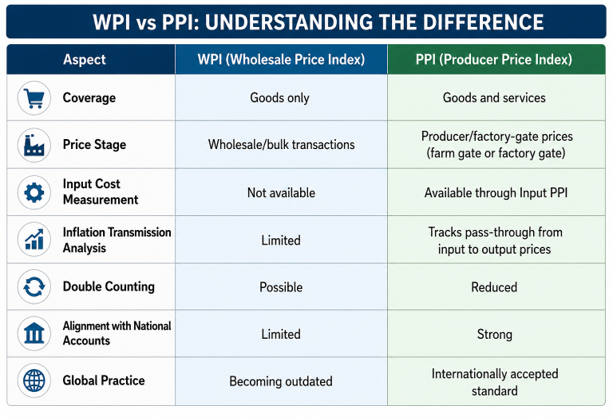
- Introduction of PPI: The Commerce Ministry will simultaneously release:
- Output PPI:
- Measures prices received by producers at the farm gate or factory gate. Excludes indirect taxes and trade/transport margins.
- Initially covers 125 items, which may expand to around 1,500 items after WPI is phased out.
- Input PPI (trial basis): Measures prices paid by producers for inputs. Includes trade and transport margins. Initially introduced for the manufacturing sector on an experimental basis.
- Services PPI:
- Covers seven major services like banking, securities transactions, insurance, pension fund management, railways, air passenger transport, and telecommunications.
- To be released quarterly, beginning with data for January–March 2026.
Why is India Shifting to PPI?
- Better reflection of production costs:
- PPI captures both: prices producers receive (output PPI), and prices producers pay (input PPI).
- This helps analyse how rising input costs are transmitted into final producer prices.
- Inclusion of the services sector: India’s economy is increasingly service-driven. Since WPI excludes services, it provides only a partial picture of inflation. PPI addresses this gap.
- Consistency with national accounts: PPI is considered more suitable for measuring sectoral inflation, deflating nominal GDP to obtain real GDP, and improving accuracy of national income estimates.
- Alignment with global best practices: Most advanced economies use PPI as the principal measure of producer-level inflation. The shift enhances international comparability of Indian statistics.
Five-Year Transition Plan (2026–2031):
- WPI remains widely used in long-term procurement contracts, infrastructure projects, construction agreements, and price escalation clauses for raw materials and machinery.
- To avoid disruption:
- WPI and PPI will be released simultaneously for five years.
- Government departments will gradually shift contractual indexing from WPI to PPI.
- New long-term contracts extending beyond 2031 are expected to adopt PPI-based escalation mechanisms.
- After the transition period, WPI is likely to be discontinued.
Significance for GDP Measurement:
- Economists and institutions such as the International Monetary Fund (IMF) have long advocated a dedicated PPI system.
- Currently, India uses a combination of CPI and WPI to convert nominal GDP into real GDP.
- Once the new PPI series becomes stable and reliable:
- Output PPI can serve as a more accurate
- Real GDP estimates may become more robust.
- National accounts methodology will become more internationally comparable.
Challenges Ahead:
- Data collection and reliability: Building reliable producer-level price databases across sectors is complex. Input PPI is still experimental and requires validation.
- Stakeholder adaptation: Industries, government departments, and businesses must modify existing contracts and pricing frameworks.
- Service sector measurement: Measuring service prices accurately remains more challenging than measuring goods prices.
Conclusion:
- The five-year coexistence of WPI and PPI aims to ensure a smooth transition while modernising India’s economic measurement system.
- To ensure the success of this transition, India must strengthen producer-level data collection systems, improve service-sector price measurement, and facilitate smooth adaptation by industries and government agencies.