Why in news?
The Supreme Court recently dismissed a challenge against orders directing a man (referred to as CP) to undergo a DNA test. The case was filed by a person claiming to be CP's biological son, who sought both a declaration of paternity and a share in CP's property.
CP had been denying the claim since 1999 — over two decades. The Court upheld the DNA test order, balancing CP's right to privacy against the alleged son's right to establish his identity and inheritance.
What’s in Today’s Article?
- Background: The Legal Framework
- Evolution Through Case Law
- The Three-Part Test: When Can a Court Order a DNA Test
- The Present Case: How the Court Decided
- Analysis: Important Dimensions Touched by This Judgement
Background: The Legal Framework
- Section 116 of the Bharatiya Sakshya Adhiniyam 2023 (Earlier it was Section 112 of the Indian Evidence Act)
- When a child is born during a valid marriage — or within 280 days of its dissolution — the law presumes that child to be the legitimate child of the husband.
- This presumption can only be overturned by proving that the husband and wife had no access to each other at the time of conception.
- Mere suspicion or assertion is not enough. The intent is clear: protect the child's legitimacy and dignity.
- The Problem: No Law Explicitly Allows DNA Testing
- There is no statute in India that expressly authorises courts to order DNA tests.
- The entire framework has evolved through judge-made law — that is, through Supreme Court judgments over the years.
Evolution Through Case Law
- The Supreme Court's position on DNA testing in paternity disputes has developed gradually, with each case adding a new layer of nuance.
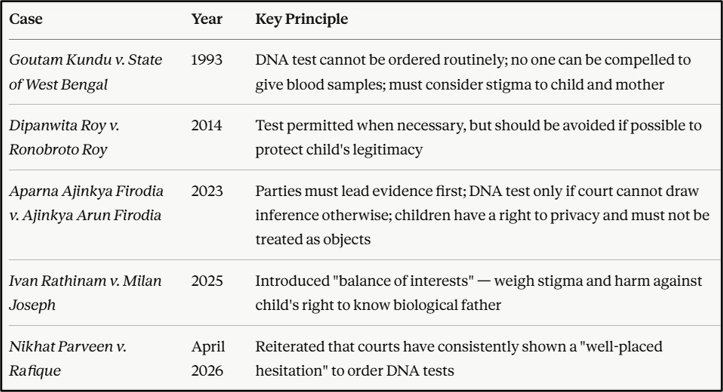
- The common thread across all these judgments: courts are reluctant to order DNA tests and will do so only as a last resort.
The Three-Part Test: When Can a Court Order a DNA Test
- The Supreme Court laid down three conditions that must be satisfied:
- Paternity must be directly in issue — it must be the central question in the case, not a peripheral one.
- No other evidence should be available — if paternity can be established through other means, a DNA test should not be ordered.
- It must be in the best interest of the parties or justice — the court must weigh the harm of ordering the test against the harm of not ordering it.
The Present Case: How the Court Decided?
- In this case, all three conditions were met. CP had denied paternity for over 20 years.
- There was no other evidence on record. The alleged son had no other way to establish his identity or claim his inheritance.
- The Court framed the issue honestly: CP's right to privacy was real, but so was the alleged son's right to closure on a question that had defined his entire life.
- Denying the test would mean denying him rights he might legitimately be entitled to — forever.
- The Court therefore upheld the DNA test order.
Ethical Dimensions Touched by This Judgement
- Right to Privacy (Article 21) — The Puttaswamy judgment (2017) recognised privacy as a fundamental right. This case shows that even fundamental rights are not absolute — they must be balanced against competing rights and interests.
- Judicial Activism vs. Judicial Restraint — Courts have built an entire framework on DNA testing without any legislative backing. This raises questions about the role of the judiciary in filling legislative gaps.
- Rights of the Child — The tension between a child's right to legitimacy and a child's right to know their biological identity is a recurring theme in family law.

