
Wage Revolution in India - From Ease of Doing Business to Dignity of Work
Context:
- The Indian Prime Minister raised a critical question in front of industry leaders at the FICCI Annual General Meeting — “I have given income tax relief up to Rs 12 lakh. But have you increased the salaries of your employees?”.
- This highlights a fundamental weakness in India's growth model. Despite tax cuts, labour reforms and ease-of-doing-business initiatives, wage growth and job quality remain inadequate.
India's Industrial Strategy:
- India has prioritised low labour costs to attract investment and integrate into Global Value Chains (GVCs).
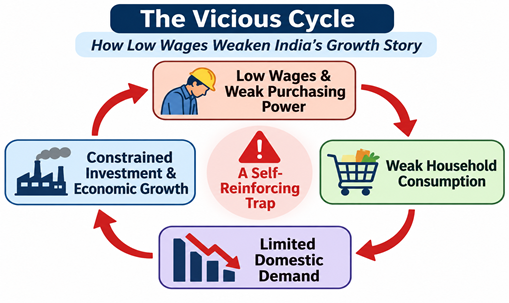
- Suppressing wage limits has adversely affected workers' purchasing power, domestic consumption and long-term economic growth.
- For example, the labour unrest in Noida-Gurgaon (April 2026) exposed the growing disconnect between industrial expansion and workers' aspirations.
- Hence, India cannot become a $10-trillion economy by keeping its workforce at subsistence-level incomes.
The Wage Crisis - India's Workers are Losing Purchasing Power:
- India's real wage growth has remained almost stagnant, undermining the benefits of economic expansion.
- For example:
- Real wage growth between Q2 FY20 and Q1 FY25 was 0.01% and real wages in Haryana and UP contracted (India Ratings).
- Annual real wage growth between FY17–FY26 is 0.23% (SBI Ecowrap).
- Real monthly earnings of self-employed men declined from Rs 9,454 (2017-18) to Rs 8,591 (2023-24) (Economic Survey 2025).
- The cumulative real wage increase over an entire decade was 2.3% (SBI estimate).
- Global comparison: India's casual industrial workers earn approximately $140–160 per month, compared with $210–240 in Vietnam.
- Implication: A labour-surplus economy cannot assume an unlimited supply of workers willing to accept poor wages. Wage dissatisfaction leads to attrition, industrial unrest and productivity losses.
The Economic Paradox - Workers are Also Consumers:
- India's growth model faces a fundamental demand-side contradiction.
- Household consumption contributes approximately 60% of India's GDP.
- However, a K-shaped recovery has enabled affluent households to drive luxury consumption while lower-income groups struggle to meet basic aspirations.
- Low wages restrict disposable income, weakening mass-market demand for goods and services.
- For instance, workers producing smartphones, automobiles and other consumer goods often lack the purchasing power to afford them.
- The vicious cycle:
Beyond Labour Reforms - Need for a Fair Wage Model:
- The consolidation of 29 labour laws into four Labour Codes is an important step towards simplifying labour regulation and strengthening worker protection.
- However, regulatory reform alone cannot guarantee economic dignity. So, a required shift is needed from the existing approach.
- For example,
- From Ease of Doing Business to Dignity of Work,
- From Cost minimisation to Fair wages,
- From Labour as a production cost to Labour as an economic asset,
- From Supply-side reforms to Supply- and demand-side reforms, and
- From Subsistence employment to Aspirational employment.
- Why should industry pay better?
- Higher productivity: Better-paid workers are generally more motivated and productive.
- Lower attrition: Fair wages reduce employee turnover and recruitment costs.
- Industrial peace: Better compensation reduces workplace dissatisfaction and unrest.
- Improved quality: Experienced and secure workers contribute to operational efficiency.
- Demand creation: Higher disposable incomes strengthen domestic consumption.
- Thus, fair wages should be treated as an investment in productivity rather than merely an additional business cost.
From Kisan-Centric to Kaamgaar-Centric Development:
- India's political and economic priorities have traditionally focused heavily on farmers (Annadata). While agriculture remains vital, the country's demographic dividend increasingly depends on non-farm workers.
- The emerging policy emphasis must recognise the contribution of:
- Blue- and grey-collar industrial workers.
- Informal-sector and gig-economy workers.
- Migrant labourers and urban workers.
- Skilled workers transitioning from agriculture to manufacturing and services.
- The government must complement its commitment to Annadata with equal attention to Shramdaata.
Way Forward - Building a Blue-Collar Middle Class:
- Fair wage framework: Encourage wages that reflect living costs, skills, productivity and workers' aspirations.
- Skill development: Link vocational training and upskilling with higher-paying employment opportunities.
- Social security: Ensure effective implementation of labour reforms, including protection for informal and gig workers.
- Responsible industry: Encourage employers to share productivity gains with employees through better compensation.
- Formalisation of employment: Expand quality jobs with predictable wages and decent working conditions.
- Strengthen domestic demand: Improve workers' disposable incomes to create a broader consumer base.
Conclusion:
- India's ambition of becoming a $10-trillion economy requires more than factories, infrastructure and investment. It requires a financially secure and aspirational workforce.
- The transition from an agriculture-based to a non-farm economy must also become a transition from subsistence wages to dignified livelihoods.
- A truly Aatmanirbhar Bharat will emerge when the worker who manufactures India's prosperity also has the purchasing power to experience it.