Why in news?
The United States and Denmark announced an agreement on Greenland's security. It comes more than a year after President Donald Trump, in his second term, revived talk of an American takeover of the island.
The deal is expected to be signed at the UN General Assembly and will enter into force only after the required parliamentary procedures. Its full text has not yet been made public.
What’s in Today’s Article?
- Greenland's Constitutional Position
- Two Descriptions of the Same Deal
- What Actually Changes on the Ground?
- A Long History of American Interest
- Why Greenland Matters Strategically
- India's Stake
Greenland's Constitutional Position
- Greenland is a self-governing territory within the Kingdom of Denmark.
- Under the 2009 Self-Government Act, its government exercises wide legislative and executive powers.
- Greenlanders retain the right to determine the island's future, including the path to independence.
- Defence and foreign affairs, however, remain with Denmark.
- This division explains why the deal was negotiated between Washington and Copenhagen (Denmark), while Nuuk's (capital of Greenland) consent remains politically essential.
Two Descriptions of the Same Deal
- The American Version - Trump said the agreement grants the US permanent control over security, and all other needs. He added that the US could do whatever it considered necessary for Greenland's defence. Adversaries, he said, would be barred from establishing bases, maintaining a military presence, or making sensitive investments in Greenland without American approval.
- The Danish version - PM Mette Frederiksen described the deal as strengthening security in the Arctic and the North Atlantic. She explicitly reaffirmed the sovereignty and territorial integrity of the Kingdom of Denmark, and the Greenlanders' right to self-determination.
- Statements from both sides indicate the deal gives the US permanent security access while leaving Danish sovereignty intact.
What Actually Changes on the Ground?
- The US already enjoyed sweeping military access in Greenland. This is why "permanent control" may overstate the practical shift.
- The 1951 US–Denmark defence agreement allowed extensive military access, including free movement between defence areas by land, sea and air, and the right to overfly and land. It remains in force.
- These rights were not unlimited. New US defence areas or facilities required Danish agreement.
- According to media reports, the new agreement makes US access, basing and overflight rights permanent, including if Greenland's political status changes in the future.
- That is the real innovation: it insulates American presence from a future Greenlandic independence.
- The crucial ambiguity is whether new facilities will still need Danish and Greenlandic consent. If yes, the military change is limited.
- If Washington gains unilateral authority over new bases or investments, the shift is far more significant.
A Long History of American Interest
- 1867: Secretary of State William Seward explored acquiring Greenland and Iceland. No formal claim followed.
- 1941: After Nazi Germany occupied Denmark, the US signed an agreement permitting airfields and defence facilities, while recognising Danish sovereignty.
- 1946: President Harry Truman offered Denmark $100 million for Greenland. Washington had earlier considered swapping parts of Alaska for parts of Greenland.
- 1951 and 2004: The defence agreements that still govern the relationship.
Why Greenland Matters Strategically?
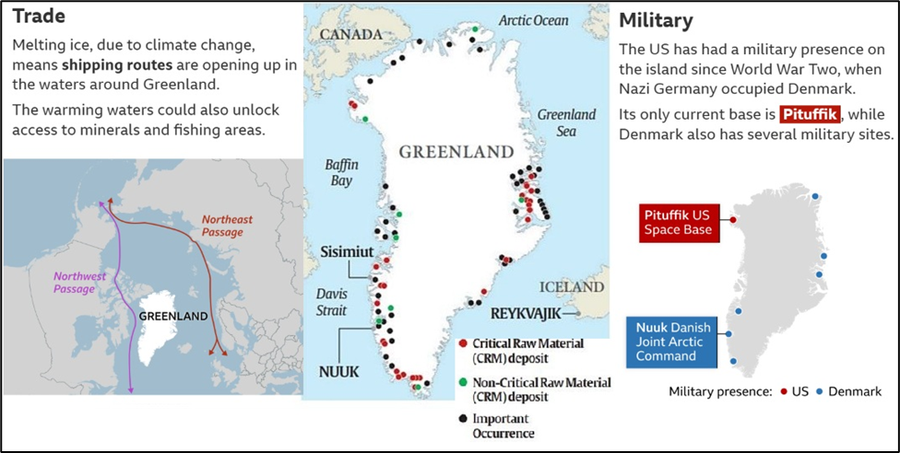
- Location - Greenland is the world's biggest island and sits in the North Atlantic Ocean, between North America and Europe. Most of the island is in the Arctic Circle and is covered by a permanent ice cap.
- Military and Missile Defence - Greenland was a vital base of operations during the Cold War (1945–91). Pituffik Space Base hosts an early-warning radar used by the US and NATO to detect missile threats and monitor Arctic activity.
- Sitting between North America and the Arctic, the island is central to tracking Russian military movement.
- China and Russia have both scaled up Arctic military capabilities in recent years.
- Critical Minerals - Greenland holds large deposits of rare earth elements and other critical minerals. These are used in mobile phones, electric vehicles, consumer electronics, and in bombs and weapons.
- China is currently the leading global supplier of many rare earths.
- Greenland's mineral wealth has therefore become part of the wider competition over critical-mineral supply chains.
- In 2021, Greenland banned mining of deposits containing uranium above a specified threshold, a decision that stalled the large Kvanefjeld rare-earth project.
- Trade - Melting ice, due to climate change, means shipping routes are opening up in the waters around Greenland. The warming waters could also unlock access to minerals and fishing areas.
India's Stake
- India is an Observer at the Arctic Council (since 2013), operates the Himadri research station at Ny-Ålesund, and released its Arctic Policy in 2022.
- Great-power militarisation of the Arctic affects the scientific commons India uses, and the rare-earth contest directly touches India's own critical-mineral security.

