Why in news?
US President Donald Trump has reversed his plan to charge a 20% fee on commercial vessels transiting the Strait of Hormuz, just a day after announcing it.
He announced to replace the 20% United States Reimbursement Fee with Trade and Investment Deals. The abrupt reversal came amid widespread scepticism from experts over the plan's legality and feasibility.
What’s in Today’s Article?
- The Original Proposal and Its Flaws
- International Opposition
- The Underlying Battle for Control of Hormuz
- India's Broader Response to the Crisis
The Original Proposal and Its Flaws
- Trump had announced that the US would become "THE GUARDIAN OF THE HORMUZ STRAIT" and, as a matter of fairness, be reimbursed at 20% on all cargo shipped to cover the costs of providing security in the region.
- However, the proposal left several critical questions unanswered:
- Calculation ambiguity: It was unclear whether the fee would apply to the total value of cargo, the cost incurred by American forces, or some other formula.
- Cost impact: If based on total cargo value, shipping costs through the strait would have risen sharply, significantly increasing the landed price of commodities.
- Implementation and legality: Questions arose over how the fee would be enforced and its legality under international law.
- Security guarantee: The US's ability to guarantee safety of commercial vessels was doubtful, given its response to Iranian strikes had so far been only retaliatory, without pre-emptive protective measures.
International Opposition
- The International Maritime Organization (IMO) firmly opposed the plan, stating there is no legal basis to impose mandatory tolls for transiting straits used for international navigation.
- Notably, the US has traditionally championed freedom of navigation and had strongly opposed Iran's attempts to charge tolls for the same strait, making Trump's proposal a reversal of Washington's own long-held position.
- Also, this could have inadvertently strengthened Iran's case for imposing its own tolls.
The Underlying Battle for Control of Hormuz
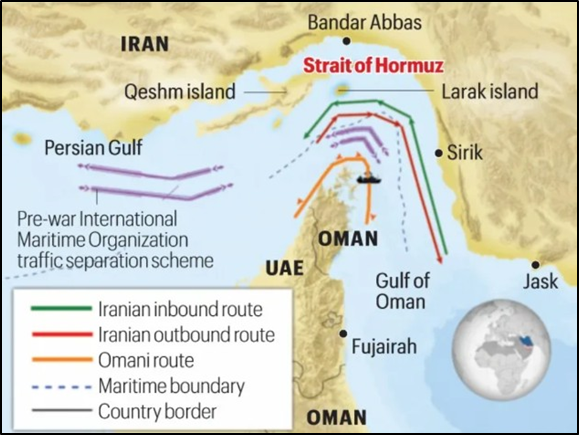
- The fee flip-flop reflects a deeper contest between the US and Iran over control of the strategically vital waterway:
- An interim US-Iran pact signed on June 17, 2026 had promised to reopen the Strait of Hormuz, and vessel transits rose meaningfully thereafter, though still below pre-war levels of up to 140 daily transits.
- Renewed tensions caused vessel transits to crash to their lowest levels in nearly a month.
- Iran's Foreign Minister asserted that Iran, not the US, has "always been the GUARDIAN of the Strait," while also calling Trump's 20% figure excessive.
- Since the war began in February 2026, Iran has claimed sovereignty over parts of the strait and targeted vessels sailing outside its authorised shipping lanes, while the US has struck Iranian military targets in response.
- Iran closed the strait to commercial vessels over the preceding weekend, prompting the US to reinstate a naval blockade in the region.
- Under UNCLOS, straits are natural waterways with no general transit charge, though neither the US nor Iran has ratified this convention; it is nonetheless widely accepted as customary international law.
Why This Mattered for India?
- Had the fee been implemented, it would have significantly impacted India as a major energy importer:
- India sources around 40% of its crude oil, 60% of its LNG, and 90% of its LPG imports from West Asia via the Strait of Hormuz.
- India's import dependence stands at over 88% for oil, 60% for LPG, and about 50% for natural gas.
- A 20% fee on a $75/barrel crude oil price would have pushed the landed cost to over $90/barrel.
- Assuming 30% of India's oil imports continued via Hormuz, the fee alone could have added $9 billion annually to India's oil import bill, excluding additional costs for LNG, LPG, fertilisers, and industrial inputs.
- Every $1/barrel rise in oil prices increases India's annual oil import bill by up to $2 billion, given India imports 1.8-2 billion barrels of crude annually.
India's Broader Response to the Crisis
- India has consistently advocated that navigation through international waterways like the Strait of Hormuz should remain free and accessible to all.
- Diversified crude sourcing helped maintain adequate oil supplies, but the government had to ration gas supplies to certain industries and take emergency measures to prevent panic fuel buying; some of these were rolled back after the June MoU improved the situation.
- India's oil imports surged 47% year-on-year to $48.88 billion in March-May 2026, as the country prioritised supply security over cost, as per Ministry of Petroleum and Natural Gas data.
- Elevated energy import costs have wider ramifications for India's trade balance, current account, inflation, and the rupee's exchange rate.
Conclusion
Trump's rapid U-turn exposed the impracticality of unilaterally taxing a strategic international waterway, legally, diplomatically, and economically. For India, it underscores continued vulnerability to West Asian energy disruptions, reinforcing the need for diversified sourcing and sustained advocacy for free global navigation.

