Why in news?
The Supreme Court has agreed to examine whether the Digital Personal Data Protection (DPDP) Act, 2023 can be used to weaken the Right to Information (RTI) Act, 2005, by classifying all data as "personal," and whether it separately curtails investigative journalism.
The Court is hearing multiple petitions challenging DPDP Act provisions, primarily Section 44(3).
What’s in Today’s Article?
- The Core Legal Question
- Different Scope of the Two Laws
- Section 44(3) of the DPDP Act: What It Changes in the RTI Act
- Impact on Investigative Journalism
The Core Legal Question
- The Court noted that both the DPDP Act and the RTI Act are central legislations, and there is a need to harmonise them.
- It observed that while the RTI Act granted access to information with certain conditions, the DPDP Act imposes an "en bloc embargo" — a blanket restriction.
- The Court will examine whether this later law is repugnant to the earlier RTI law, treating the matter with "extreme circumspection" since both are central statutes.
Different Scope of the Two Laws
- The apex court pointed out that the RTI Act operates in a much larger domain, covering all forms of data — physical and digital.
- The DPDP Act, by contrast, is concerned only with data in digital form.
- The Court acknowledged that most data today is overwhelmingly digital, but this distinction remains legally significant.
- The Court will examine whether the DPDP Act's restrictive "cautionary approach" to sharing data effectively repeals earlier transparency legislation like the RTI Act.
Section 44(3) of the DPDP Act: What It Changes in the RTI Act
- Section 44(3) of the DPDP Act directly amended Section 8(1)(j) of the RTI Act 2005 - — expanding the scope for denying information on grounds of protecting personal data.
- Original RTI provision: Authorities could deny personal information only if it had no relation to public activity or if disclosure amounted to unwarranted invasion of privacy — but even then, information had to be disclosed if public interest outweighed privacy.
- This balancing was done by a Public Information Officer or First Appellate Authority, weighing both privacy and transparency.
- After the amendment: The "larger public interest" clause has been removed. All personal information is now broadly exempt from RTI disclosure, regardless of whether disclosure would serve the public interest.
- How This Affects RTI Requests?
- Experts contend that this inverts the right to privacy — a right meant to protect citizens from State overreach — into a shield that instead protects the State and public functionaries from RTI disclosures.
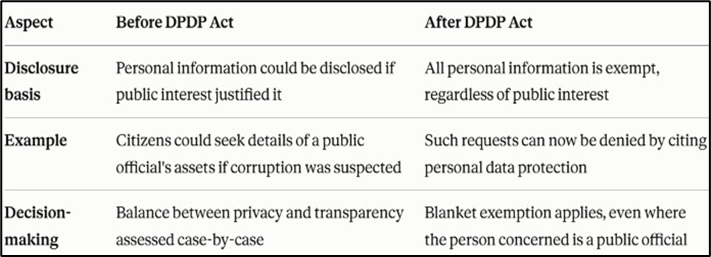
- By removing the public-interest override, the amendment shifts the RTI framework from a case-by-case balancing test to a blanket, one-size-fits-all exemption.
- This means information that was previously accessible — such as details relevant to exposing corruption or misconduct by public officials — can now be denied simply by labelling it "personal data," without any assessment of whether disclosure would actually serve the public good.
Impact on Investigative Journalism
- As per the experts, the DPDP Act poses a grave threat to investigative journalism:
- The Act grants no exemption to journalists.
- Journalists reporting on individuals would need to seek the consent of the "data principal" (the person the data belongs to).
- If the data principal demands erasure of data, they can do so — directly undermining investigative reporting that relies on retaining and using such information.
No Special Category for Journalists
- The Court clarified that journalists cannot be treated as a "special category" with unrestricted access to data.
- It noted that neither the landmark Subhash Chandra Agarwal case (on public transparency) nor the Indian Express Bombay Pvt Ltd case (on press freedom), nor the RTI Act itself, had ever granted journalists such special status.
- Even so, the Court agreed to examine the broader impact of the DPDP Act on journalistic activity.
Conclusion
This case sets up a crucial test of how India balances two constitutional values — the right to privacy and the right to information.
The Court's eventual ruling will determine whether data protection safeguards meant for citizens can be used by the State to shield itself from public scrutiny and accountability.