Why in news?
Saudi Arabia temporarily shut its East-West oil pipeline, also called Petroline, after multiple attacks on the network. The attacks hit the Riyadh and Madinah regions and caused an unspecified number of injuries.
Both Saudi Arabia and Iraq say the attacks originated in Iraq, where Iranian-backed militias operate. Saudi authorities described the shutdown as precautionary while technical teams assess safety. The extent of damage and the duration of the shutdown remain unclear.
This comes at a time when global oil supplies are already strained by disruption in the Strait of Hormuz.
What’s in Today’s Article?
- A Dangerous New Front
- What the East-West Pipeline Is
- The Pipeline's Role During the Hormuz Crisis
- Other Hormuz-Bypass Pipelines in West Asia
- Likely Impact on Oil Markets
- The Worry for India
A Dangerous New Front
- The pipeline attack coincided with Yemen's Houthi rebels seizing the strategically vital Mayun Island at the entrance to the Red Sea.
- Iran-backed Houthi forces have tightened their grip around the Bab el-Mandeb and Red Sea shipping route.
- Together, these developments mark a dangerous expansion of the wider war with Iran and threaten the very route Saudi Arabia has relied on since Persian Gulf shipping effectively halted.
What the East-West Pipeline Is?
- Runs roughly 1,200 km across Saudi Arabia, from the Abqaiq oil processing centre in the oil-rich east to the Red Sea port of Yanbu in the west.
- Operated by Saudi Aramco.
- Allows crude to move overland to the Red Sea, bypassing the Strait of Hormuz.
- Built partly as a hedge against disruption of oil flows through Hormuz.
- From Yanbu, tankers bound for Asia sail through the Bab el-Mandeb, while those headed west use the Suez Canal.
Why Hormuz Matters?
- The Strait of Hormuz is the narrow waterway between Iran and Oman. Before the West Asia war began over six months ago (late February), it carried a fifth of global oil flows.
- It is the main outlet from the Persian Gulf, on which Saudi Arabia, Iraq, Kuwait, Qatar and the UAE have depended to reach global markets, especially China and India.
The Pipeline's Role During the Hormuz Crisis
- Petroline can carry around 7 million barrels per day (bpd), of which about 5 million bpd is available for export and the rest feeds domestic refineries.
- Before the war, the pipeline ran at a fraction of capacity as exports through Hormuz were normal. Once maritime traffic through the chokepoint ground to a halt, Aramco began pumping far more oil through Petroline.
- Actual flows in recent months are estimated at 4–5 million bpd, which represents 4–5 per cent of global oil supplies. The pipeline has thus served as a vital safety valve.
- Its targeting shows that alternative routes themselves can become targets in a regional conflict.
Other Hormuz-Bypass Pipelines in West Asia
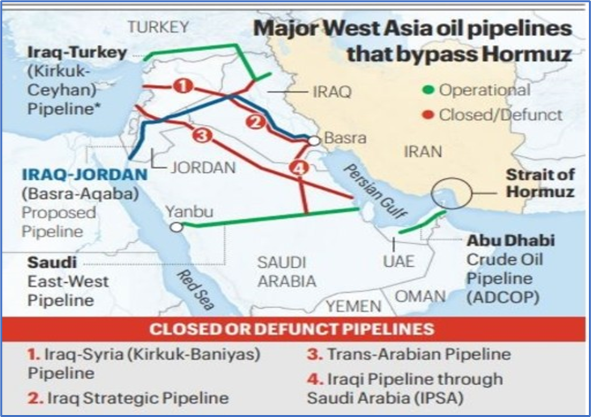
- Operational: Saudi East-West Pipeline; Abu Dhabi Crude Oil Pipeline (ADCOP) in the UAE; Iraq-Turkey (Kirkuk-Ceyhan) pipeline, operating at marginal capacity.
- Closed or defunct: Iraq-Syria (Kirkuk-Baniyas) pipeline; Iraq Strategic Pipeline; Trans-Arabian Pipeline; Iraqi Pipeline through Saudi Arabia (IPSA).
- Proposed: Iraq-Jordan (Basra-Aqaba) pipeline.
Likely Impact on Oil Markets
- Brent crude crossed $100 a barrel recently after attacks on tankers and petroleum infrastructure in the region. The Petroline shutdown arrives when traders are already nervous.
- Analysts consider three scenarios:
- Quick repair within days, no further attacks: Prices could retreat from current levels. Tankers can be redirected, inventories drawn down and other Saudi export infrastructure used.
- Shutdown lasting weeks, with continuing threats around Hormuz and Bab el-Mandeb: Prices could move higher.
- Wider conflict: Attacks spreading to more Saudi facilities, Yanbu, tankers or other Gulf export infrastructure could trigger a broad supply shock and sharply higher prices.
The Worry for India
- Saudi Arabia has traditionally been among India's top crude suppliers.
- Despite falling supplies during the Hormuz crisis, Saudi oil still accounted for 7–8 per cent of India's total oil imports in recent months, most of it shipped from Yanbu.
- The first impact will be on supplies, forcing Indian refiners to find replacement volumes.
- This is manageable given India's diversified import slate. The bigger headache is higher prices for alternative barrels.
- India's Rising Oil Import Bill
- India's crude import bill surged over 56 per cent year-on-year in April–July to $63.4 billion, even though volumes rose only slightly to 81.9 million tonnes from 81.5 million tonnes.
- India is the world's third-largest crude consumer and imports over 88 per cent of its requirement.
- India imports 1.8–2 billion barrels a year. Every $1-per-barrel rise adds up to $2 billion to the annual import bill.
- Every 10 per cent rise in oil prices widens the current account deficit by about 0.4 per cent of GDP.
- Higher energy imports affect the trade balance, current account, inflation and the rupee. An oil shock acts as an external tax on the Indian economy.
Conclusion
The Petroline attack exposes the fragility of even the alternative routes that have kept global oil flowing during the Hormuz crisis. For India, the immediate risk is price rather than supply, but a prolonged shutdown or wider conflict could severely strain its import bill, current account and inflation. Energy diversification and strategic reserves remain critical.

