Why in the News?
- The Supreme Court, in Just Rights for Children Alliance v. S. Harish (2026), recognised the importance of internet access for children and emphasised the need to balance digital freedom with age-appropriate safeguards.
What’s in Today’s Article?
- Internet Access as Fundamental Right (Constitutional Framework, Global Approach, Judicial Developments, Balancing Freedom & Safety, etc.)
Internet Access as a Fundamental Right
- Access to the internet has become essential for education, information, communication, creativity and participation in modern society.
- The Supreme Court's observations in Just Rights for Children Alliance v. S. Harish (2026) reinforce the importance of internet access, particularly for children, as a gateway to knowledge, creativity and self-expression.
- The constitutional basis for this right can be understood through the following provisions:
- Article 19(1)(a): Guarantees freedom of speech and expression, which includes the ability to access, receive and communicate information through the internet.
- Article 19(1)(g): Protects the freedom to practise any profession or carry on any occupation, trade or business, including activities conducted through the internet.
- Article 21: Protects life and personal liberty, encompassing the broader right to live with dignity and access essential opportunities in a digital society.
Constitutional Framework: Authority-Liberty Coordination
- A constitutional democracy must maintain a balance between the authority of the State and the liberty of citizens. This principle can be described as authority-liberty coordination.
- Reasonable restrictions are necessary to reconcile individual freedoms with wider social interests. The Constitution places limits on both State authority and the exercise of individual liberty.
- Excessive State interference can lead to authoritarian tendencies and undermine fundamental freedoms.
- Unrestrained exercise of individual rights can disregard legitimate social interests and public safety.
- The objective is to ensure that restrictions remain constitutionally justified, proportionate and consistent with democratic principles.
- In the context of children's internet access, this means protecting children from harmful online experiences without unnecessarily restricting their fundamental freedoms.
Global Approaches to Children's Online Safety
- Several countries have introduced restrictions or safeguards to regulate children's access to social media and digital platforms.
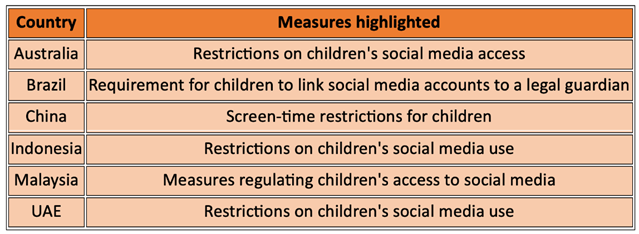
Image Caption: Global Approaches to Children's Online Safety
- In India, States such as Andhra Pradesh and Karnataka have also considered measures to regulate children's screen time.
- These approaches reflect growing concerns about excessive screen exposure, harmful online content and the vulnerability of children in digital spaces.
- However, regulatory approaches adopted by other countries cannot automatically be replicated in India. Restrictions must be evaluated in light of India's constitutional framework, social conditions and the importance of digital inclusion.
Judicial Developments on Internet Access and Digital Rights
- The Supreme Court has progressively recognised the relationship between digital access and fundamental rights through several important judgments.
- Anuradha Bhasin v. Union of India (2020)
- The Supreme Court held that freedom of speech and expression under Article 19(1)(a), and the freedom to carry on trade or business under Article 19(1)(g), are protected when exercised through the internet.
- The judgment also emphasised that restrictions on internet services must satisfy constitutional requirements and be subject to judicial scrutiny.
- Pragya Prasun v. Union of India (2025)
- The Supreme Court held that excluding persons with disabilities from digital Know Your Customer (KYC) procedures violated Article 21.
- It recognised digital access as an intrinsic component of the right to life, highlighting the State's responsibility to ensure that digital systems are accessible and inclusive.
- Secretary, Ministry of Information and Broadcasting v. Cricket Association of Bengal (1995)
- The Court recognised that Article 19(1)(a) includes the right to know, receive and impart information and ideas.
- This principle provides an important foundation for understanding access to information as an essential component of freedom of expression.
- Just Rights for Children Alliance v. S. Harish (2026)
- The judgment highlighted the importance of internet access for children and challenged the assumption that safety and freedom are necessarily contradictory.
- It emphasised that protecting children does not automatically require restricting their digital freedom. Instead, the focus should be on creating an environment in which children can explore the internet safely while exercising their fundamental rights.
Balancing Digital Freedom with Online Safety
- The central challenge is to ensure that protective measures do not unnecessarily undermine children's access to information and opportunities.
- A blanket prohibition on internet or social media access may prevent children from benefiting from educational resources, digital services and opportunities for self-expression.
- Instead, a preventive and collaborative approach involving multiple stakeholders is necessary.
- Role of Parents and Guardians
- Parents should encourage responsible internet use, establish age-appropriate boundaries and help children recognise online risks. Digital awareness should focus on informed decision-making rather than excessive restrictions.
- Role of Government
- The government should establish appropriate regulatory frameworks to restrict harmful content, protect children's privacy and ensure accountability of digital platforms.
- Role of Educational Institutions
- Schools and educational institutions should integrate digital literacy and cyber safety awareness into education, enabling children to identify risks and use online resources responsibly.
- Role of Digital Service Providers
- Technology companies and online platforms should strengthen content moderation, privacy safeguards, age-appropriate settings and mechanisms for reporting harmful activities.
- The emphasis should be on preventive safeguards and shared responsibility rather than restricting children's fundamental rights as a corrective measure after harm has occurred.