Why in news?
Actor Imran Khan, a US citizen and Overseas Citizen of India (OCI) cardholder, was asked by the Foreigners Regional Registration Office (FRRO) to leave India by October 28.
The FRRO issued the notice days after he joined a protest on October 10 at Mumbai’s August Kranti Maidan, demanding the resignation of Chief Election Commissioner Gyanesh Kumar. The episode raises a crucial constitutional question: what powers does the government actually hold over OCI cardholders?
What’s in Today’s Article?
- Who Is an OCI, and What Rights Does the Status Carry?
- Can an OCI Be Asked to Leave for Joining a Protest?
- OCI Registration Cancellation: A Separate, Stricter Process
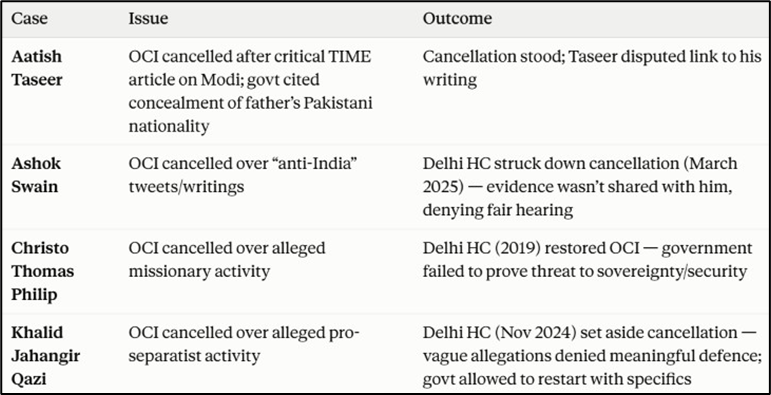
- Precedents: How Courts Have Handled OCI Cancellations
- What Can Khan Do Now?
Who Is an OCI, and What Rights Does the Status Carry?
- The OCI scheme was introduced in 2005 for certain foreign nationals of Indian origin.
- India does not permit dual citizenship — an OCI remains a foreign national holding another country’s passport.
- Key privileges: A multiple-entry lifelong visa, and exemption from FRRO registration regardless of stay duration. OCIs also get parity with Indian citizens/NRIs in certain property, educational, and professional matters.
- Restrictions Under a March 2021 Notification
- OCIs need special permission before undertaking:
- Research, missionary/Tabligh work, mountaineering, journalistic activity.
- Certain employment/internships in foreign diplomatic establishments.
- Entering protected, restricted, or prohibited areas.
- Crucially: political protests are NOT listed among activities requiring prior permission.
- Political Rights Denied to OCIs
- Under Section 7B of the Citizenship Act, OCIs cannot vote or contest elections.
- Article 19 rights (freedom of speech, peaceful assembly) are guaranteed specifically to citizens, not OCIs.
Can an OCI Be Asked to Leave for Joining a Protest?
- The Immigration and Foreigners Act, 2025 (in force since September 2025, replacing the Foreigners Act, 1946) gives the government wide powers over foreign nationals — and an OCI remains a foreigner for this purpose.
- No explicit ban exists on foreigners attending political rallies, but the law grants considerable executive discretion.
- Provisions Invoked Against Khan
- Section 7(2)(c): Empowers government to direct a foreigner shall not remain in India or in any specified area therein.
- Section 29: Empowers removal of a foreigner for violating the Act/rules, or based on an adverse security report. Officers may exercise reasonable enforcement powers.
- Key insight: The statute doesn’t designate “political protest” as prohibited conduct — but it gives the executive latitude to prohibit activities through specific orders or directions.
- Delegation of power: A September 2025 notification delegated powers under Sections 7(2) and 29 to FRROs and Foreigners Registration Officers — not confined to the Union Home Ministry alone.
- A Relevant Precedent: The Kamil Siedczynski Case (2020)
- The Calcutta High Court quashed a Leave India Notice against Kamil Siedczynski, a Polish student who had joined an anti-CAA rally in Kolkata.
- The Court, applying the then Foreigners Act, held that mere participation in a political rally alone was insufficient to justify such action.
- It should be noted that the 2025 Act has since replaced that law, though it retains similarly broad executive powers.
OCI Registration Cancellation: A Separate, Stricter Process
- This is governed by Section 7D of the Citizenship Act — distinct from a “Leave India” notice.
- Grounds For Cancellation
- OCI obtained through fraud, false representation, or concealment.
- Disaffection towards the Constitution.
- Helping an enemy during war.
- Conviction for serious crime (in specified circumstances).
- Widest ground — Section 7D(e): Cancellation where the government deems it necessary for sovereignty, integrity, security of India, friendly relations with foreign countries, or “the general public.”
- Key safeguard: Unlike the power to direct a foreign national to leave India, cancellation expressly requires that the person be given a reasonable opportunity to be heard.
Precedents: How Courts Have Handled OCI Cancellations
- Courts have consistently struck down cancellations where evidence wasn’t disclosed or allegations were too vague to allow a fair defence.
What Can Khan Do Now?
- He can seek withdrawal/reconsideration from the FRRO or Central Government — but no comparable “right to be heard” is spelt out under Section 7 (unlike Section 7D cancellations).
- His stronger remedy: Approach the High Court under Article 226, challenging the notice’s legality and seeking interim protection. His lawyers have reportedly already done so.
- Unless withdrawn, modified, or stayed, the notice requires him to leave India by October 28.
Conclusion
The Imran Khan episode exposes a structural asymmetry in how Indian law treats OCI cardholders: while cancelling OCI status demands a fair hearing under Section 7D, the “Leave India” power under the 2025 Immigration Act offers no equivalent procedural safeguard, resting instead on broad executive discretion.
Past precedents — from Siedczynski to Swain to Qazi — suggest courts are willing to intervene when vague allegations substitute for evidence, but each case turns on specific facts. Whether Khan’s challenge succeeds will likely hinge on the same question: did mere participation in a protest, without more, justify invoking the law’s broadest immigration powers?