Why in the News?
- The Government informed Parliament that the number of individuals reporting a gross total income of Rs. 100 crore or more increased to 576 in Assessment Year (AY) 2025-26, marking a fourfold rise over the past five years.
What’s in Today’s Article?
- 100 Crore Club (Background, Key Highlights of Govt Data, Income Inequality, Significance, etc.)
Background
- The issue came into focus after the Ministry of Finance, in a written reply in the Lok Sabha, shared data on taxpayers reporting gross total income of Rs. 100 crore or more.
- The response was provided by the Minister of State for Finance in reply to a parliamentary question regarding the increasing number of billionaires in India.
- The government clarified that there is no statutory definition of the term "billionaire" under either the Income-tax Act, 2025 or the erstwhile Income-tax Act, 1961.
- Therefore, instead of providing data on billionaires based on wealth, it furnished statistics on individuals who reported an annual gross income of at least Rs. 100 crore in their Income Tax Returns (ITRs).
- The latest figures indicate a significant increase in the number of ultra-high-income taxpayers.
- At the same time, the government stated that it does not maintain data on the aggregate wealth of taxpayers, making income tax return statistics one of the few official sources for analysing the distribution of high incomes in the country.
- The disclosure comes at a time when the Ministry of Statistics and Programme Implementation (MoSPI) is conducting India's first National Household Income Survey, which aims to generate comprehensive data on household incomes, sources of income, and the impact of technology on wages.
- The survey commenced in April 2026 and is expected to conclude in March 2027.
Key Highlights of the Government Data
- Rise in Rs. 100 Crore Income Earners
- The number of individuals reporting a gross total income of Rs. 100 crore or more has increased substantially over the past five assessment years.
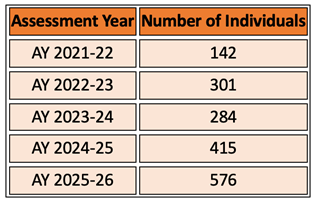 Image Caption: Rise in Rs. 100 Crore Income Earners
- The latest figure represents:
- A 39% increase over the previous assessment year
- More than a fourfold increase compared to AY 2021-22
- Assessment Year and Financial Year
- The government clarified that an Assessment Year (AY) refers to the year in which income earned during the preceding Financial Year (FY) is assessed for tax purposes. For example: FY 2024-25 -> AY 2025-26.
- Thus, the latest data relates to income earned between April 2024 and March 2025.
- No Official Definition of Billionaire
- The Ministry clarified that the term "billionaire" has no legal or statutory definition under India's income tax laws.
- While media reports often use the expression "rupee billionaire" for individuals earning at least Rs. 100 crore annually, the government officially reports only gross total income declared in Income Tax Returns, not billionaire status.
- It also noted that one billion rupees is equivalent to Rs. 100 crore, which explains the popular usage of the term "rupee billionaire."
- No Official Wealth Database
- The government informed Parliament that it does not maintain data on the aggregate wealth of taxpayers. Consequently:
- Official information is available on declared income, not on net wealth.
- Estimates of wealth concentration generally rely on studies conducted by independent organisations rather than government databases.
Income Inequality in India
- During the parliamentary discussion, the government was also asked whether it had studied the impact of increasing concentration of income and wealth on inequality, employment, investment, and inclusive growth.
- Government's Position
- The government cited recent official data to indicate improvements in several socio-economic indicators.
- Declining Gini Coefficient
- According to the Household Consumption Expenditure Survey (HCES) 2023-24, the Gini Coefficient declined to 0.237 in rural areas & 0.284 in urban areas.
- The government stated that these figures indicate an improvement in consumption inequality.
- Improvement in Labour Market Indicators
- The unemployment rate for persons aged 15 years and above declined from 3.6% in 2022 to 3.1% in 2025.
- Labour markets have recovered beyond pre-pandemic levels in both rural and urban India.
- Government Measures
- Progressive income tax structure
- Increased expenditure on food security
- Higher public spending on health and education
- Housing initiatives
- Expansion of social security programmes
- Independent Estimates
- Independent studies present a different perspective on inequality.
- According to the World Inequality Report 2026, published by the World Inequality Lab at the Paris School of Economics:
- The top 10% of income earners account for nearly 58% of India's national income.
- The bottom 50% receive only about 15% of the national income.
- The richest 10% own approximately 65% of total wealth.
- The top 1% alone hold nearly 40% of the country's wealth.
- The report concludes that income and wealth inequality in India remain among the highest globally.
Significance
- The latest tax data provides important insights into the changing distribution of high-income taxpayers in India. It highlights:
- Rising number of individuals reporting very high incomes.
- Growing importance of tax return data for analysing income distribution.
- Need for reliable household income statistics.
- Continuing policy debate on income and wealth inequality.
- Importance of balancing economic growth with inclusive development.
- The ongoing National Household Income Survey is expected to provide a more comprehensive picture of income distribution and complement existing tax-based data.

