Why in News?
- The newly elected government in Nepal has raised objections to India and China for planning to conduct the Kailash Mansarovar Yatra through the Lipulekh Pass, a disputed tri-junction.
- This has revived longstanding boundary tensions rooted in historical treaties and competing territorial claims.
What’s in Today’s Article?
- Background - The Lipulekh Dispute
- Positions of Stakeholders
- Historical Evolution of the Dispute
- Key Issues and Challenges
- Way Forward
- Conclusion
Background - The Lipulekh Dispute:
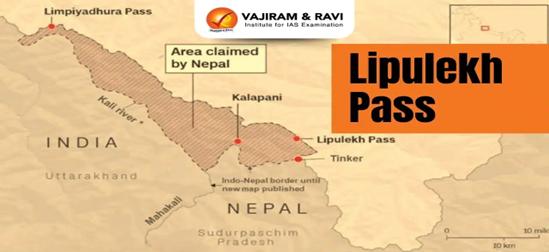
- Strategic location: Lipulekh Pass lies at the India-Nepal-China tri-junction and serves as a key route for trade and pilgrimage.
- Historical basis:
- Nepal claims the region based on the Treaty of Sugauli of 1816.
- It asserts that Limpiyadhura, Lipulekh, and Kalapani, east of the Mahakali River, belong to Nepal.
- India’s stand: Lipulekh has been a traditional route for the Kailash Mansarovar Yatra since 1954. It rejects Nepal’s claims as “unjustified and not based on historical evidence.”
- China’s role: Engaged in trade resumption with India through Lipulekh (2025), adding a trilateral dimension to the dispute.
- Immediate trigger:
- India’s announcement (April 2026) to resume the Kailash Mansarovar Yatra (June–August) via Lipulekh.
- Nepal’s formal diplomatic protest to both India and China, calling the route part of its sovereign territory.
Positions of Stakeholders:
- Nepal:
- Reiterates territorial sovereignty based on historical treaties, maps, and evidence.
- Demands halt to infrastructure, trade, and pilgrimage activities in the disputed region; preferably trilateral negotiations involving China, emphasizing resolution through diplomatic means.
- India:
- Asserts longstanding customary usage of Lipulekh for pilgrimage.
- Blame Nepal’s territorial claims as “artificial enlargement”.
- Supports bilateral dialogue mechanisms to resolve boundary issues.
- Significance of route for India:
- Geopolitical: Maintaining influence in Nepal amid growing China presence.
- Security: Strategic control over Himalayan passes.
- Cultural diplomacy: Ensuring continuity of pilgrimage routes.
- China: Maintains trade cooperation with India via Lipulekh, and has been informed by Nepal of its territorial claims but remains largely silent publicly.
Historical Evolution of the Dispute:
- 1954 onwards: India uses the Lipulekh route for the Mansarovar Yatra.
- 2020: Dispute intensifies after India builds a road in the region; Nepal publishes a new political map including disputed areas.
- 2025: Nepal protests India-China trade resumption via Lipulekh.
- 2026: Fresh tensions due to Yatra announcement.
Key Issues and Challenges:
- Boundary ambiguity: Different interpretations of the Mahakali River’s origin under the Sugauli Treaty.
- Nationalism and domestic politics: The boundary issue embedded in Nepal’s constitution—limits flexibility of any government.
- Strategic sensitivity: The tri-junction area has implications for India-China relations and regional security.
- Trilateral vs bilateral approach: Nepal’s demand for trilateral talks vs India’s preference for bilateral resolution.
- Impact on cultural/religious diplomacy: Potential disruption of the Kailash Mansarovar Yatra, affecting people-to-people ties.
Way Forward:
- Revitalise boundary dialogue mechanisms: Expedite meetings under existing India-Nepal boundary committees.
- Evidence-based resolution: Use historical maps, satellite imagery, and joint surveys.
- Confidence-building measures (CBMs): Temporary arrangements for pilgrimage while dispute resolution continues.
- Avoid escalatory rhetoric: Maintain diplomatic maturity to prevent strain in bilateral ties.
- Explore selective trilateral coordination: Limited engagement with China where necessary, without diluting bilateral frameworks.
Conclusion:
- The Lipulekh dispute underscores the complexities of Himalayan boundary politics, where history, geography, and nationalism intersect.
- While the Kailash Mansarovar Yatra serves as the immediate flashpoint, the underlying issue remains unresolved territorial claims.
- A calibrated diplomatic approach, rooted in dialogue and mutual sensitivity, is essential to preserve India-Nepal relations and regional stability.

