Why in news?
The newly elected government in Kerala has announced the formation of a dedicated department for elderly people — the first such initiative in India. Currently, welfare of the aged falls under the state's Social Welfare Department.
The move is driven by Kerala's rapidly ageing demographic profile — the most advanced case of population ageing among all Indian states — and signals the urgent need for geriatric governance as a distinct policy domain.
What’s in Today’s Article?
- Kerala — India's Most Rapidly Ageing State
- Why is Kerala Ageing So Rapidly? — Three Key Reasons
- Geographic and Gender Dimensions
- What Kerala Has Already Done — Existing Initiatives
- Broader Significance - India's Shifting Demographics
Kerala — India's Most Rapidly Ageing State
- Kerala is going through a critical phase of demographic transition with a demographic profile resembling East Asian and European countries far more than the rest of India.
- The Old Age Dependency Ratio — the number of aged persons per 100 working-age persons — has risen sharply from 19.6% (2011) to 26.1% (2021) and is projected to reach 34.3% by 2031.
- This means one in three working-age Keralites will be supporting an elderly dependent within a decade.
Why is Kerala Ageing So Rapidly? — Three Key Reasons
- Sharply Falling Fertility Rate - Kerala's TFR has fallen to just 1.35 — significantly below the national replacement level of 2.1 and even below India's national TFR of 1.9. Fewer births mean fewer young people entering the population — accelerating the share of the elderly.
- Rising Life Expectancy - Better healthcare infrastructure has increased life expectancy significantly — 78.4 years for women and 71.9 years for men — meaning people are living longer, swelling the elderly population.
- Large-Scale Out-Migration of Working-Age Population - A significant portion of Kerala's working-age population has migrated abroad — particularly to West Asian countries and beyond.
- Those who migrate to non-West Asian countries often settle there permanently, leaving aged parents behind — creating households with only elderly members.
- Simultaneously, return migrants from West Asia who come back after their working years add to the state's elderly population — creating a double burden.
Geographic and Gender Dimensions
- The India Ageing Report 2023 noted that 17.5% of Kerala's rural population comprises individuals aged 60 and above — compared to 15.4% in urban areas.
- This is because working-age people migrate from rural areas to cities or abroad, leaving a higher density of elderly in villages.
- A Feminisation of Ageing
- There are significantly more elderly women than men in Kerala — particularly at advanced ages.
- The sex ratio among those 80 years and above is a striking 1,651 women per 1,000 men.
- This has created a large population of widows living alone without adequate social or financial support.
What Kerala Has Already Done — Existing Initiatives
- State Elderly Commission (2025) — A first-of-its-kind quasi-judicial forum for protecting the rights and welfare of senior citizens.
- Vayomithram — A mobile medical care programme providing healthcare at the doorstep of elderly citizens.
- Samayaprabha — A daycare initiative for senior citizens.
- Kerala Care Palliative Grid — Formed in collaboration with Digital University Kerala to coordinate palliative care. Includes 1,387 government institutions and 1,227 NGOs — currently serving approximately 1.5 lakh bedridden and 4 lakh ailing individuals.
- Welfare Pension Coverage — Around 75% of the aged population is covered under welfare pension schemes.
Broader Significance - India's Shifting Demographics
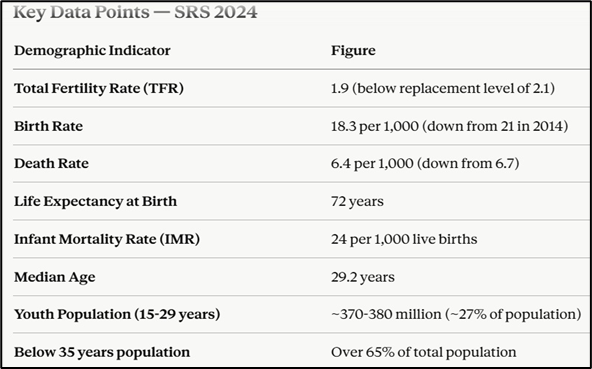
- The Sample Registration System (SRS) Statistical Report, 2024 has highlighted that India's Total Fertility Rate (TFR) has dropped to 1.9 — below the replacement level of 2.1.
- TFR is the average number of children a woman is expected to have during her lifetime.
- A TFR of 2.1 is the replacement level — the rate at which a population exactly replaces itself from one generation to the next.
- Causes of Falling Fertility Rate
- India's declining TFR is driven by several interconnected factors:
- rapid urbanisation reducing the economic utility of large families,
- better education (especially of women) leading to delayed marriages and fewer children,
- improved access to contraception enabling family planning choices,
- desire for smaller families as living costs rise and aspirations change, and
- better healthcare reducing infant mortality — reducing the need to have more children as insurance against child deaths.
- India's Demographic Dividend — Still Available, But for How Long?
- Despite the falling TFR, India still possesses a significant demographic dividend — a window of economic opportunity created when a large working-age population supports a relatively smaller dependent population (children and elderly).
- Key indicators of this window include a median age of just 29.2 years — compared to China's 40.2 and several ageing European nations.
- Approximately 370-380 million youth aged 15-29 representing ~27% of the population, and over 65% of India's population below 35 years — making India one of the world's youngest cohorts.
- However, demographic experts predict that at least three decades of population growth remain — but the window for reaping the demographic dividend will not stay open indefinitely.
- India must act with urgency to skill, educate, and employ this young population before it ages.
- The Coming Challenge — An Ageing India
- India is transitioning from a country worried about population explosion to one that must plan for an ageing population and a shrinking workforce expansion.
- This transition — well-managed by countries like Japan, South Korea, and several European nations with varying degrees of success — requires proactive policy interventions in healthcare for the elderly, pension systems, labour market flexibility, and immigration policy.
- India must reassess the path ahead and pivot to prepare for the needs of a future greying nation — before the demographic dividend disappears.