Why in news?
In November 2025, India received a 'C' grade — the second-lowest grade — from the IMF for the quality of its national accounts statistics.
In response, the government undertook a wide-ranging overhaul of its key statistical databases over the following months, improving their timeliness, representativeness, accuracy, and coverage across GDP measurement, industrial output, and inflation indices.
What’s in Today’s Article?
- What Got Updated?
- Why Was the Overhaul Necessary?
- Changes to National Accounts (GDP/GVA)
- Changes to Industrial Output (IIP)
- Changes to Inflation Indicators
- Producer Price Index (PPI) — A New Addition
What Got Updated
- Three broad categories of statistical databases were revised:
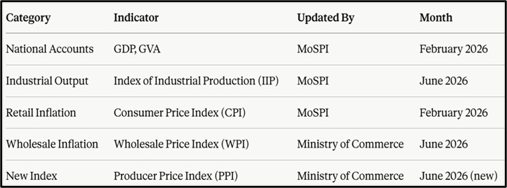
Why Was the Overhaul Necessary?
- The core problem: India's statistical databases were built on outdated base years and were becoming progressively less representative of economic reality.
- GDP, GVA, and IIP had a base year of 2011-12.
- WPI had a base year of 2011-12; CPI had a base year of 2012
- These reflected household consumption patterns nearly 15 years old.
- Old indices still measured items no longer in common use — DVDs, cassettes, VCRs, tape recorders — while missing modern items like online streaming services, CNG/PNG, and rural house rent that have since become significant in household spending.
- Why Accurate Data Matters?
- The RBI's Monetary Policy Committee uses CPI to gauge inflation and set interest rates.
- Dearness Allowance (DA) and Dearness Relief (DR) for government employees are pegged to inflation data.
- Real GDP growth — the global standard metric for measuring economic growth — is calculated only after adjusting for inflation.
- Inaccurate base data distorts policymaking across the board.
Changes to National Accounts (GDP/GVA)
- The base year was revised from 2011-12 to 2022-23, making the data far more representative of the current economy.
- Key Methodological Improvements
- Double Deflator Method - This method adjusts input and output prices separately when estimating real GDP growth — giving a much more accurate picture of how price changes affect different stages of production. Currently applied to agriculture and manufacturing, with plans to extend it to other sectors over time.
- Segregation of Multi-Activity Enterprises - Earlier, if a company operated across multiple sectors, its entire output was attributed to its main sector — distorting sectoral data. Now, output is allocated proportionately across each sector the company actually operates in, giving a more accurate sectoral picture.
- New Data Sources - The revised series now incorporates:
- GST data
- Periodic Labour Force Survey (PLFS) data
- These additions, along with improved statistical methodology, are expected to reduce data discrepancies.
Changes to Industrial Output (IIP)
- The Index of Industrial Production (IIP) — which tracks monthly industrial activity and feeds directly into GDP/GVA calculations — was updated as follows:
- Base year updated to 2022-23
- Expanded sectoral coverage: now includes gas supply, water supply, sewerage, and waste management activities (in addition to existing sectors)
- Greater granularity introduced — separately tracking renewable vs. non-renewable electricity sources and different types of minerals produced
- Products – 839 (Old Series); 1,042 (New Series)
- Item groups – 407(Old Series); 463 (New Series)
Changes to Inflation Indicators
Consumer Price Index (CPI) — Retail Inflation
- Base year updated to 2024.
- Item basket and weightages now pegged to the Household Consumption Expenditure Survey (HCES) 2023-24.
- Categories expanded from 6 groups to 12 categories.
- Total items measured (goods + services) increased from 299 to 358.
- New inclusions: Rural house rent, online media/streaming services, CNG and PNG fuel costs, and improved measurement of telephone charges, rail fare, air fare, and postal charges.
- Removed items: VCRs, DVD players, radios, tape recorders, cassettes — products no longer in common use.
Wholesale Price Index (WPI) — Producer-Level Inflation
- Base year updated to 2022-23.
- Items expanded from 697 to 957.
- Reorganised categorisation — for example, crude petroleum and natural gas moved from "Primary Articles" to the "Fuel and Power" group, aligning them with coal, electricity, and petroleum products.
Producer Price Index (PPI) — A New Addition
- The Commerce Ministry introduced an entirely new index — the PPI — in June 2026, with key distinguishing features:
- Separately tracks input prices paid by producers and output prices they receive.
- Excludes transport costs and indirect taxes (which WPI includes) — making it a purer measure of producer-level pricing.
- Incorporates both goods and services, making it more holistic than WPI.
- The Big Shift: WPI to Be Phased Out
- The government has indicated that the WPI will be phased out over the next five years, after which CPI and PPI will become India's two principal price indices — aligning India more closely with international statistical practice.
Conclusion
- Numbers shape policy — and outdated numbers shape it badly. By updating base years, refining methodology, and introducing the PPI, India has moved its statistical architecture closer to economic reality and global best practice.
- The real test now lies in sustained data quality, regular updates, and whether this overhaul finally earns India a better IMF grade.