Why in news?
The Reserve Bank of India (RBI) released data showing that India's gross Foreign Direct Investment (FDI) inflows rose to a record high of $94.53 billion in 2025-26 — up 17% from the previous year.
However, despite this record gross figure, net FDI inflows stood at a mere $7.65 billion — revealing a significant and concerning gap between headline numbers and actual retained investment.
What’s in Today’s Article?
- Understanding the Key Terms
- The Gross vs Net FDI Gap — The Real Story
- Impact on the Rupee
- RBI's Forex Market Interventions — The Scale of Defense
- The FPI Exodus — Foreign Capital Fleeing India
- Conclusion
Understanding the Key Terms
- Gross FDI — The total amount of foreign investment that flows into India before any deductions.
- Net FDI — Gross FDI minus the money repatriated (taken back) by foreign companies minus overseas investments made by Indian companies. It represents the actual net addition to India's investment stock.
- Repatriation — When foreign companies take back money they had previously invested in India — in the form of profits, dividends, or sale of assets.
- Foreign Portfolio Investment (FPI) — FPI is investment by foreign entities in a country’s financial assets like stocks and bonds. It is a passive, short-term investment, unlike FDI, which involves ownership and control of businesses.
The Gross vs Net FDI Gap — The Real Story
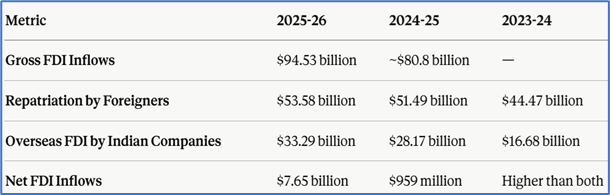
- Despite record gross inflows, net FDI has been extremely low in the past two years because of two simultaneous trends — foreign investors increasingly repatriating previously invested capital and Indian companies investing more abroad.
- Together, these two outflows nearly cancel out the record gross inflows — leaving very little net addition to India's investment base.
- Why Are Foreign Investors Repatriating?
- Repatriation at $53.58 billion — the highest in at least three years — reflects several concerns among foreign investors including:
- global risk-off sentiment,
- the West Asia war disrupting supply chains and raising uncertainty,
- rupee depreciation (making rupee-denominated returns less attractive in dollar terms), and
- profit-booking after years of strong Indian market performance.
Impact on the Rupee
- The weak net FDI inflows have been a significant contributor to pressure on the Indian rupee.
- The rupee came close to breaching the 97-per-dollar mark earlier in the week — a record low — before the RBI intervened to stabilise it.
- The rupee ended the week at 95.69 per dollar and is down 5% since the West Asia war began on February 28.
RBI's Forex Market Interventions — The Scale of Defense
- The RBI has been intervening aggressively in forex markets to defend the rupee.
- In March 2026 alone, RBI sold $29.6 billion of foreign currency on a gross basis — the highest in 13 months and the most since it sold $46.65 billion in February 2025.
- While gross forex sales in 2025-26 were less than half of the previous year, net forex sales were significantly higher — indicating that the RBI was buying back less in the forward market, reflecting a more defensive posture.
- The RBI also intervened far more heavily in the forward market last year.
The FPI Exodus — Foreign Capital Fleeing India
- Since the West Asia war began, Foreign Portfolio Investors have been exiting Indian shores in large volumes:
- March 2026 — FPI net outflows of $13.6 billion
- April 2026 — FPI net outflows of $7.56 billion
- May 2026 (so far) — FPI net outflows of $2.62 billion
- This scale of capital flight — combined with weak net FDI — is putting enormous pressure on India's Balance of Payments, forex reserves, and the rupee.
Conclusion
The record gross FDI figure is reassuring at the headline level but masks serious structural concerns. India's ability to retain foreign investment (net FDI) has weakened significantly. The rising trend of repatriation and outward FDI suggests that foreign companies are becoming more cautious about India's near-term environment.
The West Asia war has emerged as the single biggest external shock to India's capital flows — triggering both FPI outflows and forex reserve depletion simultaneously.
The RBI's aggressive intervention in forex markets has helped stabilise the rupee but at the cost of drawing down India's foreign exchange reserves. The distinction between gross and net FDI is therefore critically important — headline numbers can be misleading without understanding what lies beneath.