Why in news?
Leader of Opposition Rahul Gandhi was detained, as Opposition leaders protested in New Delhi demanding the resignation of Chief Election Commissioner Gyanesh Kumar over alleged irregularities in the ECI's Special Intensive Revision (SIR) exercise.
Since October 2, Delhi Police have detained hundreds of protesters. This raises a recurring legal question: what exactly is "detention," and how does it differ from arrest?
What’s in Today’s Article?
- Detention vs Arrest: The Core Distinction
- The Legal Provisions Enabling Detention
- Not the Same as Preventive Detention
- When Can Police Detain Protesters?
- Rights of a Detained or Arrested Person
Detention vs Arrest: The Core Distinction
- Arrest is a formal act of police taking a person into custody in connection with an offence, marking the beginning of criminal proceedings. Once arrested, a range of constitutional and statutory safeguards immediately apply.
- Detention, by contrast, is not defined by the Bharatiya Nagarik Suraksha Sanhita (BNSS), which replaced the CrPC. Instead, the BNSS grants police a set of powers to stop, remove, or temporarily hold people in certain situations — including, but not limited to, when a crime has actually occurred.
- Why disputes arise: A person may be taken away, held for hours, and released without any case being registered. To the person, it feels like an arrest. Legally, police may claim they were exercising preventive powers, not arresting someone for an offence.
- In short-term custody, "they are temporarily not allowed to leave wherever they are detained, and they are not put under a formal arrest either."
- Criticism
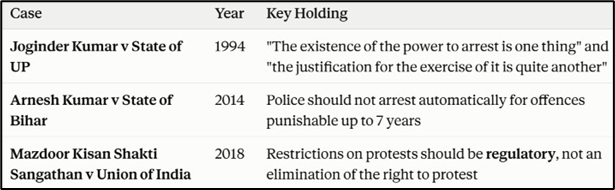
- Critics argued the distinction is often used strategically — "The police know that the power to arrest cannot be exercised casually when there is no cognizable offence punishable with more than seven years being committed by the protestors.
- A cognizable offence is one for which police can arrest without a warrant.
- If they are arrested, courts will come down heavily on them. That is why they choose to abduct people and release them within hours.
The Legal Provisions Enabling Detention
- Section 170, BNSS — Preventive action before an offence. A police officer who knows of a design to commit any cognizable offence may arrest the person without a magistrate's order or warrant, if the offence "cannot be otherwise prevented."
- Section 172, BNSS — Detaining non-compliant persons. A police officer "may detain or remove any person resisting, refusing, ignoring or disregarding" a lawful direction.
- The officer must then produce the person before a magistrate, or in petty cases, release them within 24 hours.
- What's New Here?
- Unlike the earlier CrPC, Section 172 expressly allows police to "detain or remove" someone who refuses a lawful direction.
- As per the experts, Section 172(2) BNSS is new. The CrPC had no equivalent. The CrPC did not bind citizens to obey police directions, nor let police detain those who refused. Section 172 adds both.
- They noted the idea originated from state police statutes, not the CrPC, and the 24-hour limit was itself a late addition.
- Importantly, the safeguards applicable to such short-term detentions remain largely untested — no case on this has reached the Supreme Court.
Not the Same as Preventive Detention
- This power is distinct from preventive detention, which allows holding a person without trial under special laws like the National Security Act.
- Critics content that this so-called detention has no place in law and is wholly illegal. There are preventive detention powers available, but they are subject to strict rigours of the law and cannot be casually applied spontaneously.
When Can Police Detain Protesters?
- Most protest-related detentions begin with police claiming they are preventing a law and order problem, often backed by a prohibitory order.
- On October 2, Delhi Police imposed Section 163, BNSS across New Delhi (a prohibitory-order provision).
- If protesters refuse to disperse or continue prohibited activities, police may use preventive powers to remove or temporarily hold them.
- Disobeying such an order is itself an offence under Section 223 of the Bharatiya Nyaya Sanhita (BNS). This is the point where detention can escalate into arrest with an FIR.
- Courts have set limits, though. Police action cannot be arbitrary — officers must justify why restricting liberty was necessary.
Rights of a Detained or Arrested Person
- Once liberty is restricted, several constitutional protections apply:
- Article 22 requires: production before a magistrate within 24 hours; information about grounds of arrest; and the right to legal representation.
- The Supreme Court has repeatedly held that written grounds of arrest must be furnished — and just last month, ruled that violating Article 22 safeguards makes an arrest unconstitutional.
- Section 38, BNSS allows an arrested person to meet an advocate of their choice during interrogation (though not throughout).
- Free legal aid is provided at State cost if a person cannot afford a lawyer.
- Section 43(5), BNSS bars arresting a woman between sunset and sunrise, except in exceptional circumstances with a judicial magistrate's prior permission.
- DK Basu v. State of West Bengal (1997) laid down safeguards for all cases of arrest or detention:
- Officers must wear visible name tags.
- An arrest memo must be attested by at least one witness.
- Injuries must be recorded, and family members informed.
- These safeguards are not merely advisory — non-compliant officers can face departmental action or contempt proceedings.
Conclusion
The gap between "detention" and "arrest" isn't a technicality — it's the gap between accountability and its absence. Section 172's new, untested detain-and-remove power gives police a tool with almost no litigated boundaries, even as courts insist liberty cannot be restricted arbitrarily.
Until a case like this reaches the Supreme Court, hours-long custody without an FIR will remain a legal grey zone — real enough to the person held, but outside the safeguards an actual arrest would trigger.

