Why in news?
Recently, the Union Cabinet approved a two-year Clean Mobility Scheme for Delhi-NCR. The scheme will incentivise owners of older, more polluting trucks and buses to replace them with BS-VI or stricter emission-compliant vehicles.
It is expected to benefit owners of around 2.07 lakh vehicles — 1.91 lakh trucks and 16,329 buses. Government vehicles are excluded.
What’s in Today’s Article?
- Bharat Stage (BS) Emission Norms
- Why Old Trucks and Buses Are the Problem?
- Why Old Vehicles Are So Much Worse?
- What the Scheme Proposes?
- The Broader Pollution Context
Bharat Stage (BS) Emission Norms
- Bharat Stage (BS) standards are emission regulations set by the government to limit the amount of pollutants a vehicle's engine can release.
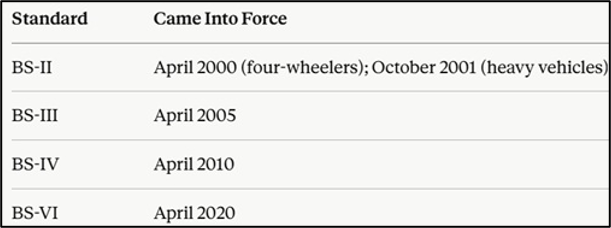
- BS-VI is the current and strictest standard. It introduced tighter limits on pollutants, mandated cleaner fuels, and required advanced onboard diagnostic systems.
- India jumped directly from BS-IV to BS-VI in 2020, skipping BS-V entirely — a significant leap in emission control.
Why Old Trucks and Buses Are the Problem?
- Delhi-NCR has 2.98 crore registered vehicles, growing at 7% per year. The transport sector is one of the dominant sources of pollution — alongside dust, industrial emissions, and biomass burning.
- But not all vehicles pollute equally. Old trucks and buses are disproportionately responsible for a large share of the damage.
- The Numbers Tell the Story
- Trucks and buses together account for 36% of PM2.5 emissions from the transport sector in Delhi-NCR.
- PM2.5 refers to fine particulate matter — particles so tiny they penetrate deep into the lungs and enter the bloodstream, causing serious respiratory and cardiovascular disease.
- A 2018 study by TERI found that the transport sector accounts for 40% of carbon monoxide and 63% of nitrogen oxide (NOx) emissions in Delhi-NCR.
Why Old Vehicles Are So Much Worse?
- A vehicle that is mechanically "fit" can still be dangerously polluting if it runs on an old BS standard.
- As engines age, parts wear out, combustion becomes incomplete, and emission controls degrade.
- Old vehicles also lack modern systems like diesel particulate filters and selective catalytic reduction that BS-VI vehicles use to clean exhaust.
- The pollution gap between old and new vehicles is staggering:
- A pre-BS norm heavy-duty vehicle pollutes 14 times more than a BS-VI vehicle.
- A BS-IV vehicle emits 2.7 times more than a BS-VI vehicle.
- A 15-year-old legacy commercial vehicle emits 11 times more PM and 6 times more NOx than a modern BS-VI vehicle.
- An old BS-I heavy-duty truck emits up to 35 times more PM than a new BS-VI vehicle.
What the Scheme Proposes?
- The scheme incentivises vehicle owners to voluntarily phase out their older trucks and buses and replace them with cleaner alternatives.
- The treatment differs by how old the vehicle is:
- BS-III and older vehicles — Scrapping is mandatory.
- BS-IV vehicles — Owners may either scrap them or sell them outside NCR, but only to areas not covered under the National Clean Air Programme (NCAP).
- This ensures that older polluting vehicles are not simply relocated from Delhi to other vulnerable cities.
- How This Fits Into India's Larger Clean Air Agenda?
- This scheme does not stand alone. Several earlier initiatives have worked towards cleaner transport in Delhi-NCR — the PM-eBus Sewa scheme for electric buses being a prominent example.
- The National Clean Air Programme (NCAP), launched in 2019, targets a 40% reduction in PM2.5 and PM10 concentrations by 2026 in 131 non-attainment cities — cities that consistently fail to meet air quality standards.
- The Clean Mobility Scheme complements these by specifically addressing the legacy vehicle problem.
The Broader Pollution Context
- Delhi-NCR's air pollution is driven by multiple sources — transport, construction dust, industries, and seasonal factors like crop stubble burning and winter weather conditions.
- Meteorology matters too. Cold, still winter air traps pollutants near the ground, which is why Delhi's pollution peaks in November and December.
- The Commission for Air Quality Management (CAQM) — a statutory body set up specifically for Delhi-NCR air quality — has been monitoring these sources and directing action.
- In data submitted to the Supreme Court in December 2025, CAQM confirmed that of the 1.61 lakh buses in Delhi-NCR, only 34,449 are BS-VI compliant — the rest, over 1.26 lakh buses, fall in the pre-BS to BS-IV category. This is a massive backlog of dirty vehicles.