Why in news?
Scientists have raised fresh concerns over the weakening of the Atlantic Meridional Overturning Circulation (AMOC), a crucial ocean current system that helps regulate global climate.
Recent research suggests the AMOC could slow by as much as 59% by 2100, potentially triggering severe disruptions in weather patterns worldwide.
The development is particularly significant for India, as changes in the AMOC could affect the summer monsoon, threatening agriculture, water security, and the livelihoods of millions dependent on monsoon rainfall.
What’s in Today’s Article?
- Atlantic Meridional Overturning Circulation (AMOC)
- Why Scientists Fear an AMOC Tipping Point?
- AMOC and the El Niño Connection
- Why a Weakening AMOC Matters for India?
Atlantic Meridional Overturning Circulation (AMOC)
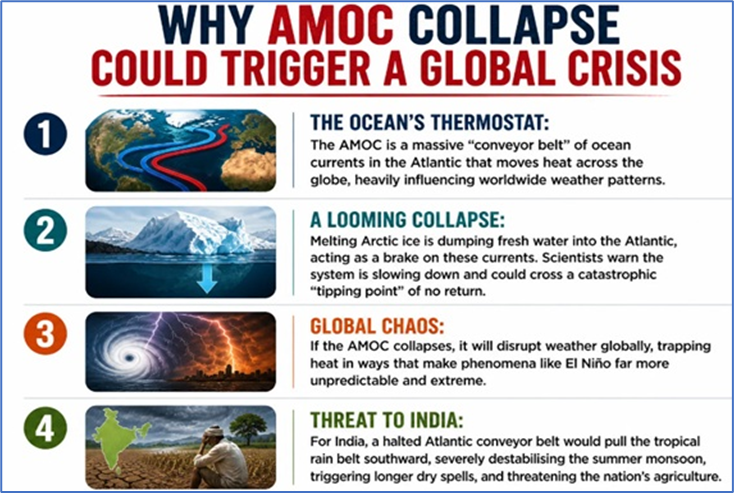
- The AMOC is a vast system of ocean currents in the Atlantic Ocean that functions like a global conveyor belt, circulating heat and water across the planet.
- Warm and salty surface water flows from tropical regions towards Greenland. In the cold Arctic region, the water cools, becomes denser, and sinks deep into the ocean.
- This cold water then travels southward through deep ocean currents before gradually rising again and warming up, restarting the cycle.
- Role in Global Climate
- The AMOC transports enormous amounts of heat around the world, helping regulate climate patterns.
- It contributes to Europe’s relatively mild climate and strongly influences rainfall and weather systems across Africa, the Americas, and Asia.
- The circulation process is extremely slow, with a single cubic metre of water taking nearly 1,000 years to complete the full cycle.
- Despite its slow pace, the AMOC plays a critical role in maintaining global climate stability.
Why Scientists Fear an AMOC Tipping Point?
- The AMOC depends on a delicate balance of temperature and salinity in the Atlantic Ocean.
- Rapid melting of Arctic ice due to climate change is releasing large volumes of freshwater into the North Atlantic.
- Freshwater is lighter and less salty than seawater, making it harder to sink into deep ocean layers. This disrupts the circulation process and slows the AMOC system, which relies on dense cold water sinking in the Arctic region.
- While earlier studies estimated the AMOC had slowed by around 15% over the past five decades, recent research using real-time ocean data suggests the weakening could reach nearly 59% by 2100.
- What is a Climate Tipping Point?
- Scientists describe the AMOC as a climate “tipping point” because once it weakens beyond a certain threshold, the system could collapse into a permanently sluggish state that may be impossible to reverse.
- A major slowdown or collapse of the AMOC could trigger severe climate disruptions worldwide, including extreme sea-level rise along North America’s coast and major disturbances in global weather and rainfall patterns.
AMOC and the El Niño Connection
- El Niño is a periodic warming of the Pacific Ocean that disrupts weather patterns across the world, influencing rainfall, droughts, storms, and temperatures.
- Although the AMOC exists in the Atlantic Ocean, its weakening can significantly affect climate systems in the Pacific due to the interconnected nature of global ocean currents and atmospheric circulation.
- A slowdown in the AMOC can trap more heat in the southern hemisphere while cooling parts of the North Pacific. This disturbs the temperature balance that helps drive El Niño events.
- Studies suggest that a weaker AMOC could make El Niño episodes more intense and less predictable.
- Strong El Niño events in 2015–16 and 2023–24 caused major global disruptions, including droughts in the Americas and reduced monsoon rainfall in South Asia.
Why a Weakening AMOC Matters for India?
- A slowdown or collapse of the AMOC could seriously disrupt the Indian summer monsoon, which is crucial for agriculture, water supply, and the broader economy.
- The AMOC helps transport heat towards the northern hemisphere. If it weakens, global heat patterns shift, causing the tropical rain belt to move southward and away from the Indian subcontinent.
- Research suggests that a weaker AMOC could reduce the strength of winds carrying moisture from the Arabian Sea into India, leading to weaker monsoon rainfall.
- The likely outcomes include:
- shorter monsoon seasons,
- longer dry periods, and
- an overall drying trend across parts of India.
- An increasingly unpredictable and intense El Niño, amplified by AMOC weakening, could further increase climate instability, exposing India to both severe droughts and destructive floods.