Why in News?
- A three-year-old tigress, T138, was released into Buxa Tiger Reserve (BTR), West Bengal, on October 2, marking the beginning of a phased programme to reintroduce tigers and establish a viable, self-sustaining tiger population in the reserve.
- The tigress was translocated from Valmiki Tiger Reserve, Bihar, in the presence of Union Environment Minister and West Bengal CM.
- Tiger reintroduction is a conservation strategy used when a species has become locally extinct but suitable habitat remains available for restoring a breeding population. Three more tigers are expected to be introduced.
What’s in Today’s Article?
- Reintroduction of T138
- Significance of Buxa Tiger Reserve
- Why did Tiger Numbers Decline in Buxa?
- Reasons for Choosing Valmiki Tiger Reserve
- India’s Experience with Tiger Reintroduction
- NTCA Protocol for Reintroduction
- Major Challenges for Buxa
- Conclusion
Reintroduction of T138:
- Initially, T138 will remain in a 2.3-hectare enclosure to acclimatise to the new environment.
- Intensive post-release monitoring through telemetry, camera traps and field-based observation will track her movement, adaptation, health and behaviour.
- The objective is not merely to increase tiger numbers, but to create ecological conditions in which a tiger population can establish, breed and eventually become viable and self-sustaining.
Significance of Buxa Tiger Reserve:
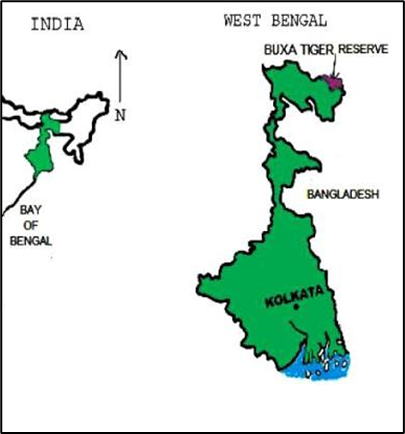
- Buxa was declared a Tiger Reserve in 1983 under Project Tiger and is the 15th Tiger Reserve in India.
- Located in the Alipurduar subdivision of Jalpaiguri district, West Bengal, it covers about 760.87 sq km. The reserve extends approximately 50 km east-west and 35 km north-south.
- It has important transboundary and landscape-level connectivity, including Bhutan to the north, Kochugaon forests (Assam), Manas Tiger Reserve (Assam) and Jaldapara National Park (West Bengal) towards the east.
- Such connectivity is crucial for wildlife corridors, gene flow and long-term population viability.
Why did Tiger Numbers Decline in Buxa?
- Buxa experienced a prolonged absence of a stable resident tiger population.
- Increasing anthropogenic pressure, habitat degradation and fragmentation, land-use changes and declining prey availability weakened the ecological conditions necessary for sustaining tigers.
- West Bengal nevertheless has an established tiger population in the Sundarbans, the world's only mangrove tiger habitat, with about 100 tigers according to the latest census.
- However, translocating Sundarbans tigers to Buxa was considered unsuitable because of major differences in terrain and habitat.
Reasons for Choosing Valmiki Tiger Reserve:
- The National Tiger Conservation Authority (NTCA) found no tigers in Buxa, Dampa (Mizoram) and Palamu (Jharkhand) Tiger Reserves and initiated a tiger reintroduction programme in 2018.
- Scientists and forest officials searched for a source population inhabiting conditions comparable to Buxa.
- Valmiki Tiger Reserve, located in the easternmost part of the Terai Arc Landscape, was considered suitable because of similarities in terrain.
- Valmiki also has ecological connectivity with the Bhutan landscape, making it relevant from a wider landscape-conservation perspective.
India’s Experience with Tiger Reintroduction:
- Tiger reintroduction in India is a major scientific and collaborative conservation effort involving the NTCA, State governments and the Wildlife Institute of India (WII).
- The programme began successfully in 2008, with tigers reintroduced into Sariska Tiger Reserve, Rajasthan, and Panna Tiger Reserve, Madhya Pradesh.
- Since then, reintroduction has been undertaken across several tiger reserves. However, outcomes have not been uniformly successful.
- The ‘Reintroduction & Population Recovery of Tigers in India’ (a publication by NTCA and WII), highlighted difficulties experienced in Satkosia Tiger Reserve, Odisha.
- Translocated tigers faced problems adapting to the new landscape, while human-tiger conflict, livestock depredation and negative local responses also emerged.
- Similarly, some tiger-release attempts in Dongarpur (Rajasthan) were unsuccessful because of multiple factors.
NTCA Protocol for Reintroduction:
- Learning from earlier experiences, the NTCA has prepared a detailed protocol on tiger reintroduction covering -
- Objectives and aims of reintroduction
- Constitution of the expert team
- Pre-project activities
- Feasibility and site-suitability assessment
- Selection and evaluation of release sites
- Selection and suitability of source tigers
- Socio-economic requirements
- Preparation for release
- Post-release monitoring and management
- This reflects the shift from simply increasing tiger numbers towards evidence-based, landscape-level conservation.
Major Challenges for Buxa:
- Human settlements and conflict: Buxa is surrounded by revenue villages and tea estates. Around 300 families are reportedly being relocated to improve the prospects of successful tiger reintroduction.
- Habitat and prey concerns: The reserve has lacked a stable resident tiger population for years, while habitat degradation and prey availability remain important ecological considerations.
- Linear infrastructure: Wildlife, particularly elephants, has been severely affected by linear infrastructure, including a railway line. Heavy commercial traffic on the road connecting Bhutan and West Bengal through Buxa adds to the pressure.
- Landscape connectivity: Maintaining functional corridors is essential because isolated populations face risks of habitat fragmentation, genetic isolation and human-wildlife conflict.
Conclusion:
- The Buxa initiative illustrates that wildlife conservation is not merely species protection but ecosystem restoration.
- Successful tiger reintroduction requires suitable habitat, adequate prey, ecological connectivity, scientific monitoring, community participation and mitigation of human-wildlife conflict.