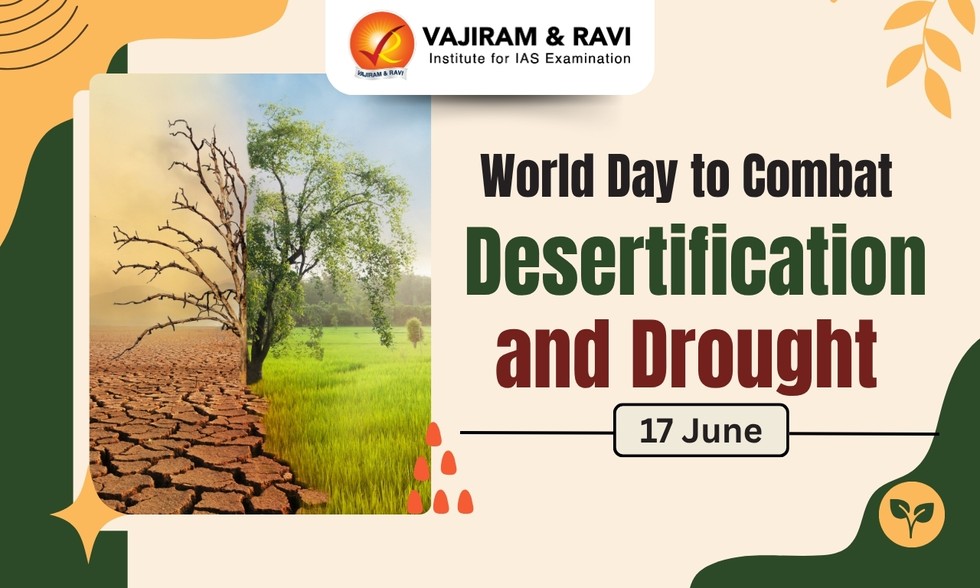
About World Day to Combat Desertification and Drought:
- It is observed annually on June 17 to spread awareness about international cooperation to combat desertification and the effects of drought.
- History:
- Desertification was identified as one of the greatest challenges to sustainable development during the Rio Earth Summit in 1992.
- In 1994, the UN General Assembly established the United Nations Convention to Combat Desertification (UNCCD).
- This legally binding international agreement linked the environment and development to sustainable land management.
- In addition to the UNCCD, the UN proclaimed June 17 as World Day to Combat Desertification and Drought.
- In 2026, the theme “Rangelands: Recognize. Respect. Restore.” highlights the importance of rangelands—ecosystems that have long been undervalued despite their critical role.
- This year’s observance also aligns with the International Year of Rangelands and Pastoralists.
What are Rangelands?
- Rangelands are expansive natural areas primarily characterized by native vegetation like grasses, shrubs, and forbs.
- Covering about 50% of the Earth's land surface, they play a vital role in supporting livestock, wildlife, and diverse ecosystems.
- These lands are not typically suitable for intensive agriculture due to limitations such as low precipitation and poor soil quality.
- Rangelands provide essential resources, including recreational opportunities and habitats for various animal species, while also serving as watersheds and mining locations.
- The dynamic nature of rangelands is influenced by numerous factors, including climate changes, grazing practices, and human encroachment.
- Rangelands store vast amounts of carbon and either originate or serve as freshwater catchment areas for most of the world’s largest rivers and wetlands.
- They support the lives of around two billion people worldwide, including many pastoralists and Indigenous Peoples whose knowledge and stewardship have sustained these landscapes for generations.
- Rangelands provide almost 70 per cent of livestock feed globally, making them critical to food systems.
- Indian rangelands occupy about 121 million hectares, from the Thar Desert to the alpine meadows in the Himalayas.
- According to the UNCCD ‘Global Land Outlook Thematic Report’, the area used for grazing is estimated at around 40 per cent of the total land surface of India, including grasslands (17 per cent), and forests (23 per cent).
- Around 70 per cent of rangelands are in the temperate region, however, a large share is considered underutilised, including degraded forest lands, land unsuitable for crop production, ravines, and wastelands.
International Year of Rangelands and Pastoralists:
- The United Nations has declared 2026 as the International Year of Rangelands and Pastoralists.
- Led by Mongolia and supported by a broad coalition of organisations, this initiative aims to raise awareness, encourage responsible investments and shape policies that safeguard rangelands and pastoralist livelihoods.
- Present in more than 75 percent of countries and managing at least one quarter of the world’s land, pastoralists herd about one billion animals worldwide.
The United Nations Convention to Combat Desertification (UNCCD):
- It is the only legally binding international agreement linking environment and development to sustainable land management.
- It was set up to address desertification and the effects of drought.
- Adopted on June 17, 1994, it entered into force on December 26, 1996 after the 50th ratification was received.
- The UNCCD is one of the three Rio Conventions—along with the UN Framework Convention on Climate Change (UNFCCC) and the Convention on Biological Diversity (CBD)—and was called for in Agenda 21, the programme of action adopted at the 1992 UN Conference on Environment and Development (UNCED, or Earth Summit).
- There are 197 Parties to the Convention, including 196 country Parties and the European Union.
- It works together to improve the living conditions for people in drylands, to maintain and restore land and soil productivity, and to mitigate the effects of drought.
- Parties to the Convention meet in Conferences of the Parties (COP) every two years, as well as in technical meetings throughout the year.
- The UNCCD permanent secretariat is located in Bonn, Germany.
National reporting:
- The UNCCD’s success relies on reliable, up-to-date information on drought, desertification and land degradation.
- Every 4 years, parties must report on the actions they have undertaken to implement the convention.