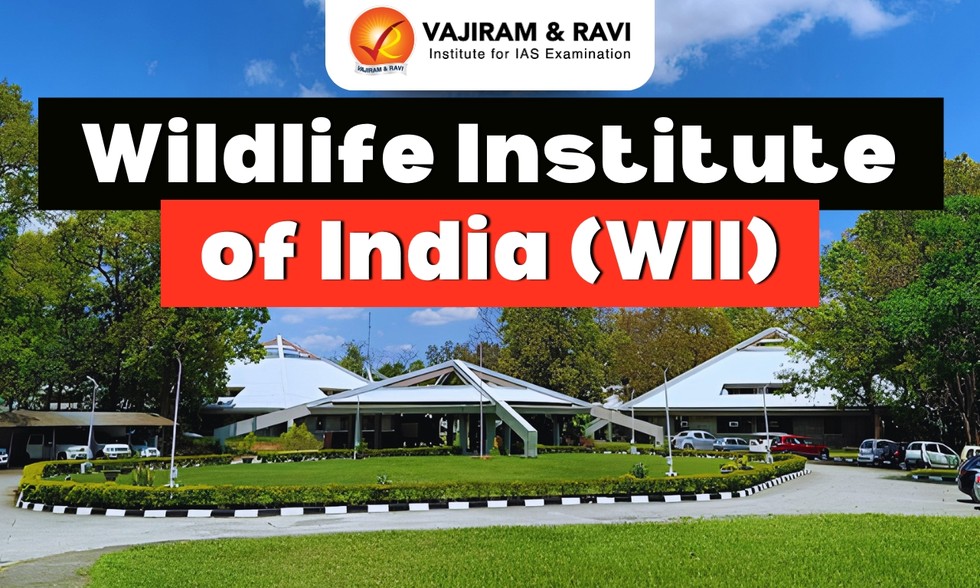
About Wildlife Institute of India (WII):
- It is an autonomous institution established in 1982 under the Ministry of Environment, Forests, and Climate Change, Government of India, for nurturing the growth of wildlife science in the country.
- Location: Dehradun, Uttarakhand.
- It is an internationally acclaimed institution that offers training programs, academic courses, and advisory in wildlife research and management.
- Objectives:
- Build up scientific knowledge on wildlife resources.
- Train personnel at various levels for conservation and management of wildlife.
- Carry out research relevant to management, including the development of techniques appropriate to Indian conditions.
- Provide information and advice on specific wildlife management problems.
- Collaborate with international organizations on wildlife research, management, and training.
- Develop as a regional centre of international importance on wildlife and natural resource conservation.
- The institute carries out research work in the fields of study, which include biodiversity, policy related to wildlife, endangered species, wildlife management, forensic wildlife research work, eco-development, spatial Modelling, and studies related to changing climatic conditions.
- A large number of foresters and wildlife managers from other developing countries, particularly south and southeast Asia, have been trained in WII since its establishment.
- Governance:
- At the apex of the WII's governance is the Society, chaired by the Ministry of Environment, Forest and Climate Change (MoEFCC).
- It has representatives from Central and State Governments, institutions, and academia.
- The institute's executive arm is the Governing Body, chaired by the Secretary (Environment & Forests), Government of India.
- It also has representatives from Central and State Governments, including six Chief Wildlife Wardens of States on a regional rotation basis.