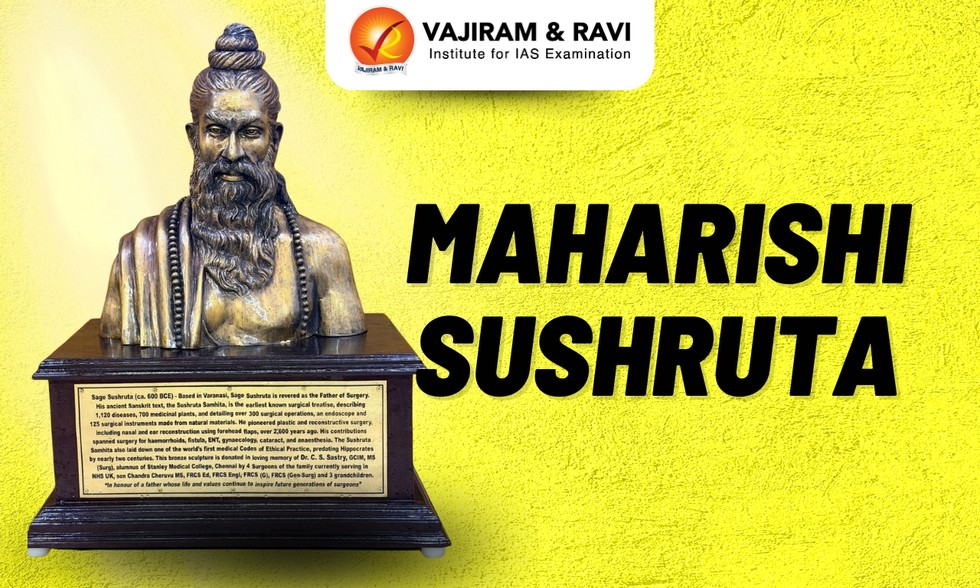
About Maharishi Sushruta:
- Sushruta, known as the “father of Indian medicine” and the “father of surgery”, was a pioneering figure in ancient Indian medicine.
- For Sushruta, the concept of shalya tantra (surgical science) was all-encompassing.
- His contributions have influenced the field of surgery, especially cosmetic surgery and medical practices within the global community.
- According to medical scholars, Sushruta lived and practiced medicine from 600 BC to 1000 BC.
- Sushruta was believed to be the disciple of the God of Ayurveda, Lord Dhanvanthri.
- He taught and practiced medicine in the city of Varanasi.
- He is known for his pioneering operations and techniques and for his influential treatise Sushruta-samhita, the main source of knowledge about surgery in ancient India.
- Though composed over 2500 years ago, it contains detailed instructions on surgery and medicine.
- The Sushruta Samhita comprises 184 chapters. This extensive work lists more than 300 surgical procedures.
- It describes over 120 surgical instruments and provides details on various types of wounds, fractures, dislocations, conditions, and their treatments.
- The Sushruta-samhita also provides details on toxicology, pediatrics, pharmacology, and other branches of the traditional system of Indian medicine known as Ayurveda.
- Furthermore, the text includes descriptions of over 100 medicinal plants, detailing their taste, usage, and effects.
- It remains one of the most important contributions to both Ayurveda and the early history of medical science.
- Examples of some of his groundbreaking operations include rhinoplasty (the repairing or remaking of a nose), removal of a dead fetus, and lithotomy (surgical incision into hollow organs such as the urinary bladder to remove stones, or calculi).
- He also developed many unique and practical techniques to dissect the human body and study its structure.
- His systematized approach to surgery, with the use of herbal anaesthetics and postoperative care, laid the foundation for surgical practices.
- Sushruta's emphasis on practical experience, dissection of cadavers, and detailed documentation established standards that continue to underpin surgical education today.
- The influence of his detailing surgical techniques and surgical instruments extended beyond ancient India, spreading to other parts of the world and shaping the development of reconstructive surgery, orthopaedics, ophthalmology, and many more fields.