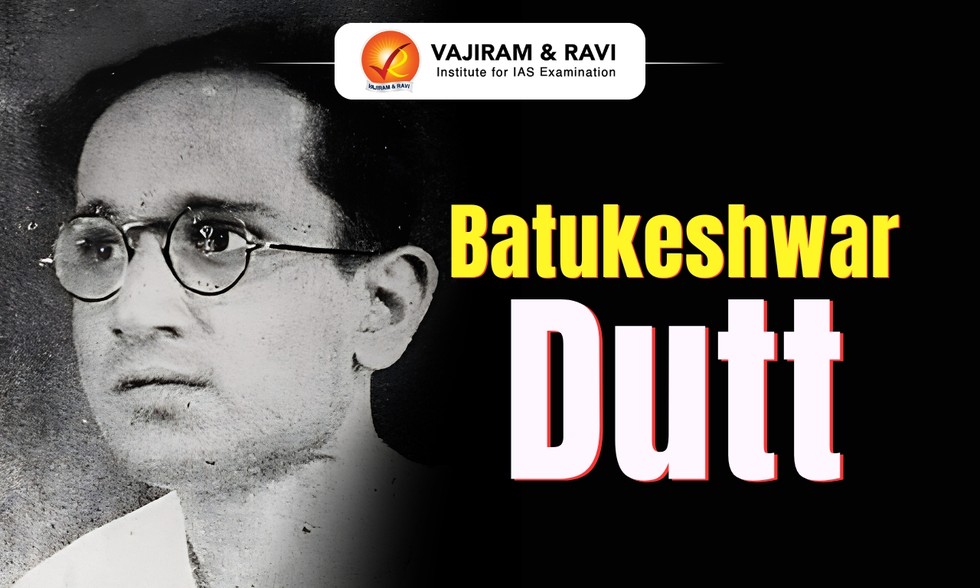
Union Home Minister and Defence Minister recently paid tribute to revolutionary and freedom fighter Batukeshwar Dutt on his death anniversary.
About Batukeshwar Dutt:
Batukeshwar Dutt was an Indian revolutionary and a freedom fighter in the early 1900s.
He was born on November 18, 1910, in Bengal’s Burdwan district.
He was a close associate of freedom fighters Chandrashekhar Azad and Bhagat Singh.
He joined the Hindustan Republican Association (HRA) and learned how to make bombs.
The Central Assembly Bombing (April 8, 1929):
He is best known for having exploded non-lethal bombs, along with Bhagat Singh, in the Central Legislative Assembly in New Delhi on 8 April 1929.
This was planned to protest the passage of the repressive Public Safety Bill and Trade Disputes Bill.
During the action, they raised the historic slogan Inquilab Zindabad! (Long Live the Revolution!), and distributed leaflets stating, ‘’if the deaf are to hear, the sound has to be very loud’’.
Bhagat Singh and Batukeshwar Dutt quietly courted arrest after the incident.
They were famously defended by M. Asaf Ali but were both sentenced to imprisonment for life.
After they were imprisoned, he and Bhagat Singh initiated a historic hunger strike protesting against the abusive treatment of Indian political prisoners and eventually secured some rights for them.
Bhagat Singh was also tried for his involvement in the murder of British police officer John Saunders, along with Rajguru and Sukhdev. He was sentenced to death and executed on 23rd March 1931.
After Dutt’s release, he took part in the freedom struggle notably in the Quit India Movement. He was jailed again for four years.
He passed away on July 20, 1965.
He was cremated in the Hussainiwala National Martyrs Memorial in Punjab. This is the same place where his friends Bhagat Singh, Shivaram Rajguru, and Sukhdev Thapar were cremated.
Dear Student,
You have still not entered your mailing address. Please enter the address where all the study materials will be sent to you. (If applicable).