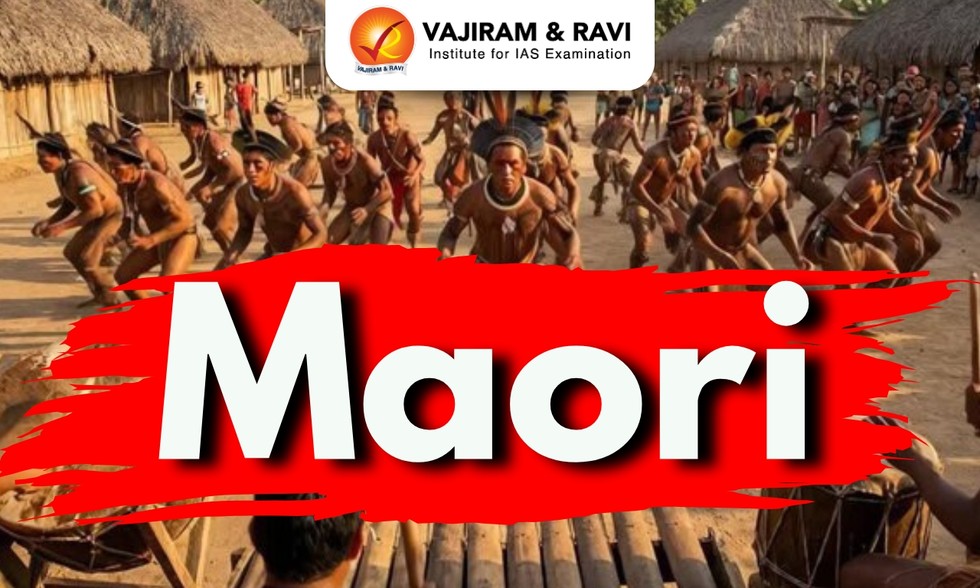
Addressing the Indian community in Auckland, the Prime Minister of India recently invoked the Maori concept of 'waka' to describe India-New Zealand ties.
About Maori:
The Maori Tribe is an indigenous tribe, which has inhabited New Zealand for centuries.
New Zealand consists of two islands, the North Island and the South Island.
The South Island is larger and more mountainous than the North Island.
The vast majority (86%) of present-day Maori live on the North Island.
They first arrived on the islands in the early 13th century.
Today Māori make up about a sixth of New Zealand’s population.
Culturally, they are Polynesians, most closely related to eastern Polynesians.
Maori culture has endured centuries of torture and struggle, first in the hands of the ‘Crown’, and later others who wished to claim a spot on their land.
Language:
Maori is classified as part of the Polynesian group of the Eastern Oceanic Branch of the Austronesian languages.
Approximately one-third of the Maori still speak their ancestral language, with the vast majority fluent in English as well.
The Māori language is an official language of New Zealand.
At the center of Māori tradition is the marae—a sacred, communal meeting ground.
The marae usually consists of buildings and an open space.
It is used within the community for important meetings, communal meals, arts and crafts, and cultural shows.
A famous aspect of Maori culture is the Haka, a powerful war dance known for its intensity, facial expressions, and rhythm.
Their distinctive costumes serve as a visual expression of their heritage, reflecting their deep connection to the land and ancestral spirits.
Another very prominent identity of the Maori people is their tattoos, which can be seen on their faces.
These tattoos are called ‘ta moko’ which is a traditional Maori art form, deeply symbolic and respected.
Ta moko designs are unique to each person and are a depiction of their social status, their genealogy, what they have done for society, and more.
In recent decades, there has been a resurgence of Māori culture and activism, particularly following the civil rights movements in the 1960s and the establishment of the Treaty of Waitangi Act in 1975, which allowed for claims regarding historical grievances.
What is Waka?
Waka means a canoe or vessel.
However, in Maori culture, the meaning of waka goes far beyond that of a boat. It symbolises a shared journey, unity, and cooperation.
Dear Student,
You have still not entered your mailing address. Please enter the address where all the study materials will be sent to you. (If applicable).