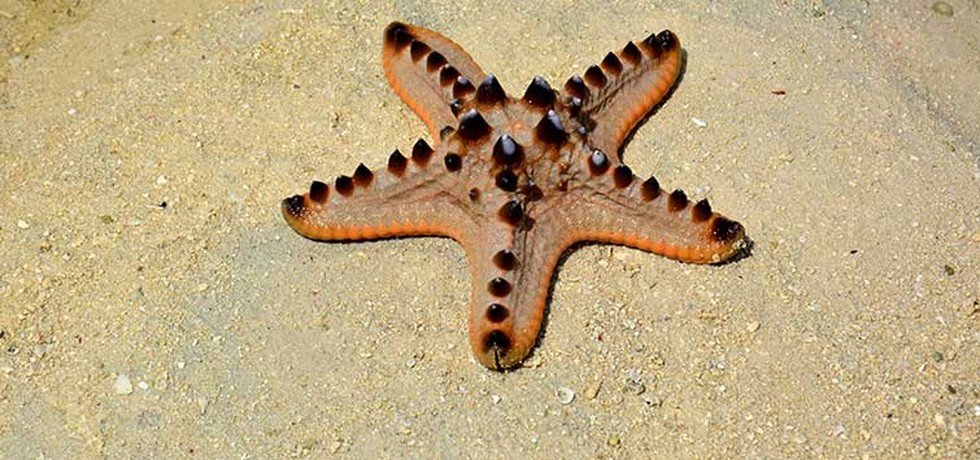
About Chocolate Chip Sea Star:
- Chocolate Chip Sea Star, also known as the horned sea star, is a species of highly recognizable ornamental sea star.
- Scientific Name: Protoreaster nodosus
- Habitat and Distribution:
- They are found in the warm, shallow waters of the Indo-Pacific region, including the Red Sea, the Indian Ocean, and the western Pacific Ocean.
- They inhabit coral reefs, sandy lagoons, and seagrass beds, typically at depths of up to 30 meters.
- Features:
- They have a creamy white base and dark brown projections, resembling chocolate chips.
- Often they are tan-colored, but they can be other shades as well.
- Like all sea stars, they can regenerate lost body parts.
- When threatened, they can lose one of their five limbs (a process known as autotomy) to escape predators, and the lost limb may regenerate over time.
- They are carnivores and typically feed on detritus, small invertebrates, and even the soft tissue of corals.
Key Facts about Sea Stars:
- Although sea stars are often called “starfish,” they’re not related to fish.
- They are invertebrates related to sea urchins, sea cucumbers, and sand dollars, which are all echinoderms.
- ‘’Echinoderm’’ means spiny skin—a reference to their hard, calcified skin, which helps to protect them from predators.
- They have radial symmetry and tube feet that help them move using water pressure.
- There are close to 2,000 species of sea stars in the world’s oceans. Most species have five arms, but some have many more—even as many as 40.
- They are often found under rocks or in crevice Their mouth, on the underside of their body, has no teeth.
- When feeding, sea stars wrap their arms around their prey and push their stomach out of their mouth to eat their food.
- They’re toxic to some predators, but if captured, sea stars can drop an arm to try to escape.
- They can regrow lost arms—and even an entire new body from a single arm and part of the central disc of their body.