
What is the Blue Flag Certification?
Three beaches in Maharashtra—Ladghar and Guhagar in Ratnagiri district and Shrivardhan in Raigad district — recently received the international Blue Flag certification for the 2026–27 season, marking the first time beaches from the State have secured the recognition.
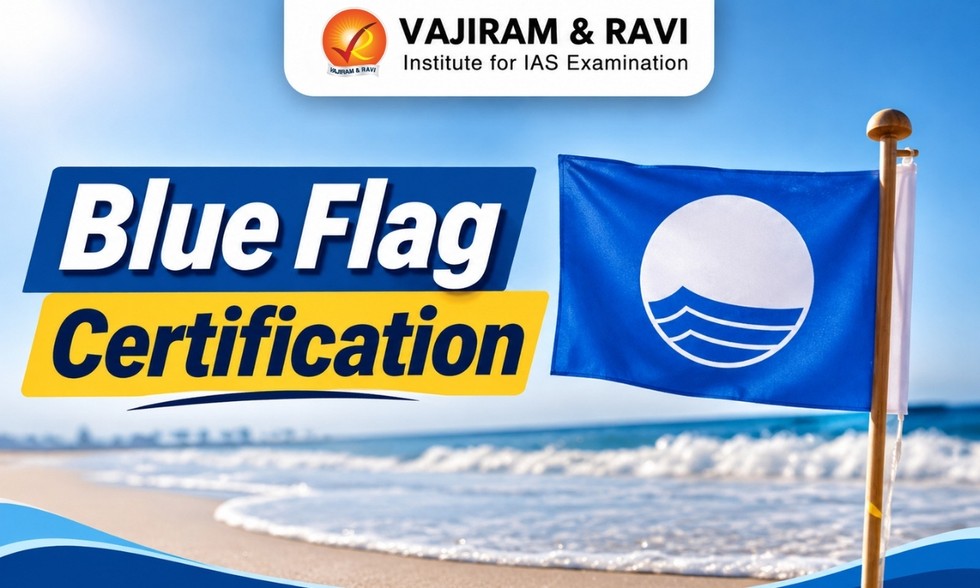
About Blue Flag Certification:
- It is a globally recognized eco-label accorded by the Foundation for Environmental Education (FEE) in Denmark.
- It is one of the world’s most recognised voluntary awards for beaches, marinas, and sustainable tourism boats.
- The Blue Flag Programme started in France in 1985. It has been implemented in Europe since 1987 and in areas outside of Europe since 2001.
- It promotes sustainable development in freshwater and marine areas.
- The award encourages local governance bodies, including Panchayats, Municipalities, district and state administrations, to commit to sustainable coastal development.
- The candidate beaches applying for the Blue Flag award are evaluated based on their compliance to the 33 international criteria in four major heads: environmental education and information, bathing water quality, environment management and conservation, and safety and services on the beaches.
- Currently, there are over 5,000 Blue Flag sites worldwide across 51 countries.
- Of all Blue Flag-certified sites worldwide,6 percent sit in just six countries. Spain leads the world with 794 certified sites, followed by Greece (658), Türkiye (628), Italy (612), France (488), and Portugal (438).
- Chandrabhaga Beach, located on the Konark coast of Odisha, was the first beach in India to receive the Blue Flag Certification in 2018. It was also the first beach in Asia to receive this certification.
- The Centre for Environment Education (CEE) is the National Operating Agency for the Blue Flag in India.
Key Facts about the Foundation for Environmental Education (FEE) in Denmark:
- It is a leading international non-governmental organisation dedicated to promoting sustainable development through environmental education.
- Established in 1981 and headquartered in Copenhagen, Denmark, FEE works with a global network of over 110 member organisations in more than 85 countries.
- FEE empowers people to rise to the most defining challenges of our time: the escalating climate crisis, the devastating loss of biodiversity, and the relentless tide of environmental pollution.
- FEE’s work is delivered through five internationally recognised programmes:
- Green Key– an international eco-label for tourism and hospitality that promotes sustainable business practices.
- Blue Flag– a leading eco-label for beaches, marinas, and tourism boats that meet stringent environmental and safety criteria.
- Eco-Schools– the world’s largest sustainable schools programme, empowering students to drive environmental action in their schools and communities.
- Young Reporters for the Environment (YRE)– a network that supports young people to investigate environmental issues and propose solutions through journalism, photography, and video.
- Learning about Ecosystems and Forests (LEAF)– a programme that promotes outdoor, nature-based learning focused on forests and ecosystems.
- Green Key Indonesia operates under this global Green Key programme, ensuring that certified establishments in Indonesia follow criteria and processes that are aligned with FEE’s internationally benchmarked standards.
Source: Three Maharashtra Beaches receive international Blue Flag certification for the first time