
What is the Beddome's bronzeback?
Scientists recently described a new tree snake species, Beddome's bronzeback, from the Western Ghats.
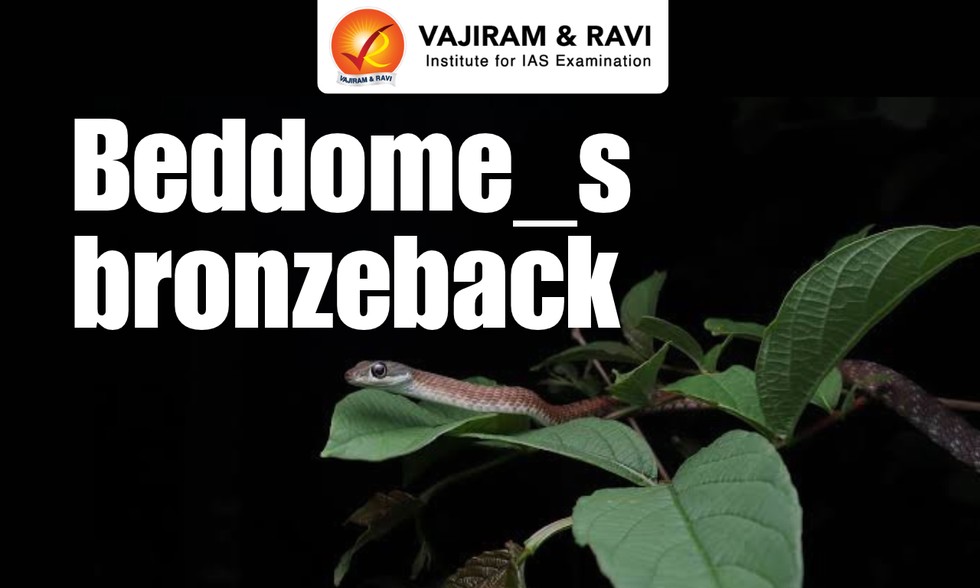
About Beddome's bronzeback:
- It is a newly identified species of tree snake from the Western Ghats.
- Scientific Name: Dendrelaphis beddomei
- It has been named after Colonel Richard Henry Beddome (1830–1911) in recognition of his contributions to the study of biodiversity in the Western Ghats, particularly reptiles and amphibians.
- The discovery resolves a longstanding taxonomic confusion with the closely related large-eyed bronzeback (Dendrelaphis grandoculis).
- The two species differ in several physical characteristics, including tongue colour, scale counts, and body markings.
- The Beddome's bronzeback has a red or pink tongue, while the large-eyed bronzeback has a black or dark-grey tongue.
- The newly described species also frequently displays a white stripe or a series of spots along the lower sides of its body and sometimes prominent black blotches on its back. These features are absent in the large-eyed bronzeback.
- It has a longer loreal scale, located between the eye and nostril, and a smaller second postocular scale, situated behind the eye.
- The number of paired scales beneath its tail can reach 168, compared with fewer than 133 in the large-eyed bronzeback.
- Different Habitat Preferences:
- The large-eyed bronzeback primarily inhabits evergreen and semi-evergreen rainforests at elevations between 300 and 1,260 metres above sea level.
- Beddome's bronzeback, by contrast, favours lower elevations on the western, windward slopes of the Western Ghats. It has been recorded at elevations ranging from 44 to 1,038 metres.
- It occurs predominantly in secondary forests, forests along waterways, and agricultural landscapes, including rubber and areca nut plantations.
- Distribution modelling suggests that the new species is most likely to occur in parts of the central Western Ghats, particularly between Puttur and Jog Falls in Karnataka.
- Other potentially suitable habitats extend from Wayanad in Kerala to Uttara Kannada in Karnataka.
- The large-eyed bronzeback, meanwhile, is predicted to occur across a wider stretch of the Western Ghats, including several mountainous regions in southern and central parts of the range.
Source: New species of tree snake identified in Western Ghats