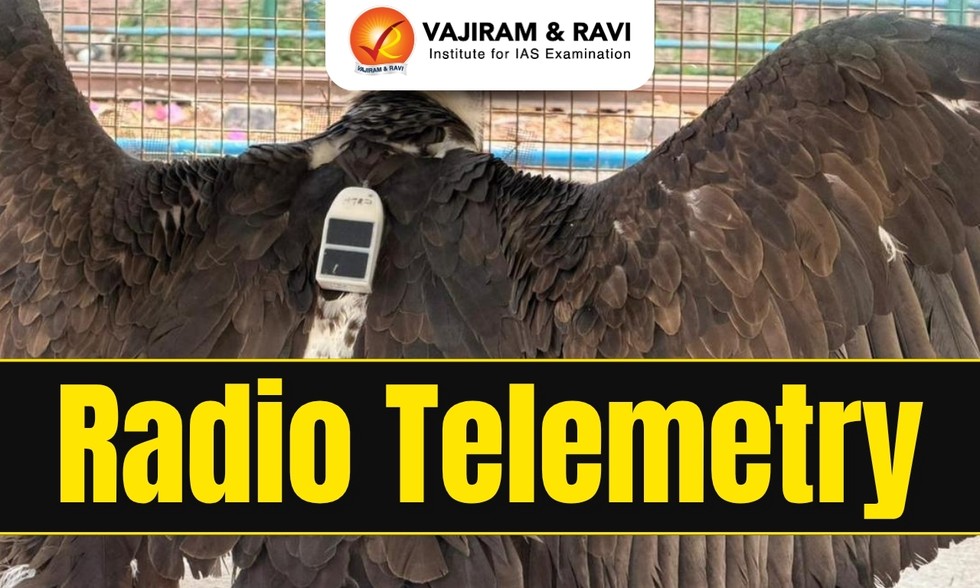
Radio telemetry data helped conservationists repeatedly protect the radio-tagged White-rumped vulture Z25, but the bird was ultimately killed in a collision with a power transmission line.
About Radio Telemetry:
Radio telemetry involves using radio waves to automatically transmit data from remote or inaccessible sources to a receiving station for monitoring and analysis.
It is commonly used in wildlife tracking, weather monitoring, industrial process control, and medical monitoring to gather data without needing physical access to the source.
Radio Telemetry in Wildlife Tracking:
Since the 1960s, scientists have been using radio telemetry to track wildlife, studying their migration patterns, behaviors, and habits.
Radio telemetry uses radio signals, which are made up of invisible and silent electromagnetic waves, to determine location.
A radio telemetry system is made up of three parts: a radio transmitter, a radio antenna, and a radio receiver.
The transmitter can be attached or tagged to the subject using a collar, an ear tag, or a wing tag for birds in particular. It is the part that transmits, or sends, the radio signal.
The operator uses an antenna, attached to a receiver, which is programmed to the transmitter’s frequency, to pick up the radio signals given off by the transmitter affixed to the target animal.
Receiver antennas may be hand-held, mounted on an object, or affixed to towers to avoid interference from buildings and trees.
They may also be fixed to a vehicle, boat, or aircraft to allow the operator to exploit larger areas.
The radio signals are then transformed into a beeping sound by the receiver.
As the receiver gets closer to the transmitter, the beeps get louder, meaning the animal wearing the transmitter is close by.
The researcher can use this audible clue to locate and follow the animal wearing the transmitter.
Limitations:
However, unlike GPS satellite tracking, radio telemetry requires researchers to remain within the signal range of the transmitter to locate the tagged animal.
The other limitation is the size and lifespan of the battery required to power the transmitter.
Dear Student,
You have still not entered your mailing address. Please enter the address where all the study materials will be sent to you. (If applicable).