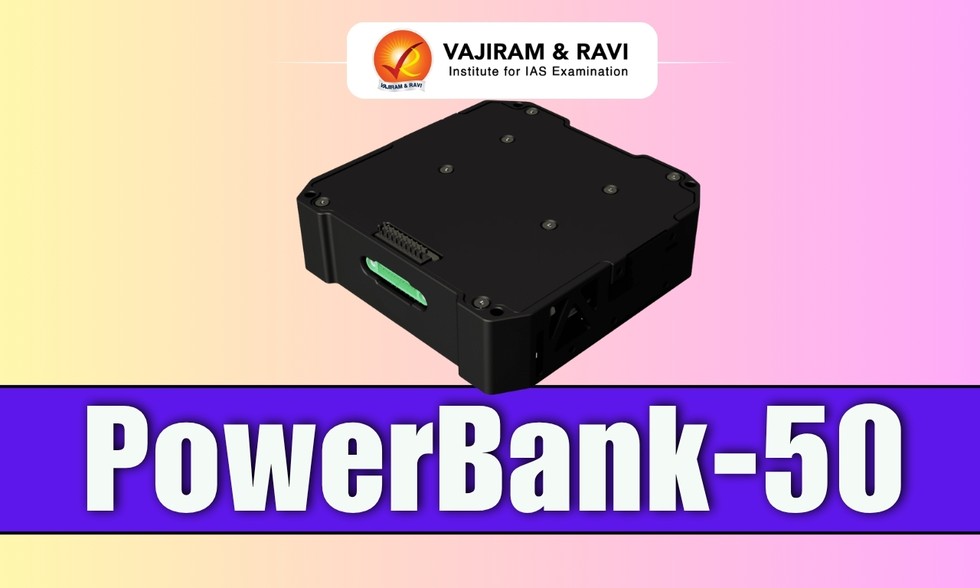
About PowerBank-50:
- It is an indigenously built satellite battery pack developed by Hyderabad-based spacetech startup TakeMe2Space.
- It is India's first indigenously developed satellite battery to earn the coveted 'flight heritage' status.
- The recognition comes after the battery pack has successfully completed its first mission aboard Skyroot Aerospace's Vikram-1 on its maiden flight -- Mission 'Aagaman'.
- Vikram-1 became the first privately developed Indian rocket to reach orbit, making India only the third country in the world, after the United States and China, where a private company has achieved orbital launch capability.
- A PowerBank-50 unit powered Cosmoserve Space’s experimental payload aboard the rocket’s Orbital Adjustment Module (OAM) at an altitude of 450 km.
- The battery performed as designed throughout launch and in the harsh conditions of space, including vacuum, radiation, and extreme temperature
- PowerBank-50 Features:
- It is a compact lithium-ion battery pack designed specifically for small satellites.
- It stores over 50 Wh of energy and is equipped with an intelligent battery management system, onboard heaters, and an aluminium flight enclosure.
- Multiple PowerBank-50 units can be stacked together to power CubeSats and microsatellites, with an operational life of up to five years in low-Earth orbit.
Why ‘flight heritage’ Matter?
- In the satellite industry, ‘flight heritage’ is the hardest credential to earn.
- Satellite builders, launch providers, and insurers are deeply reluctant to fly components that have never flown, because a single subsystem failure can end a multi-crore mission.
- This creates a well-known barrier for new suppliers: you cannot get ‘heritage’ without flying, and you cannot fly without that tag.
- The bar is highest of all for batteries that are among the most safety scrutinised components on any rocket.
- Batteries must survive intense launch vibration and shock, then operate reliably in vacuum through extreme hot and cold cycles every orbit.