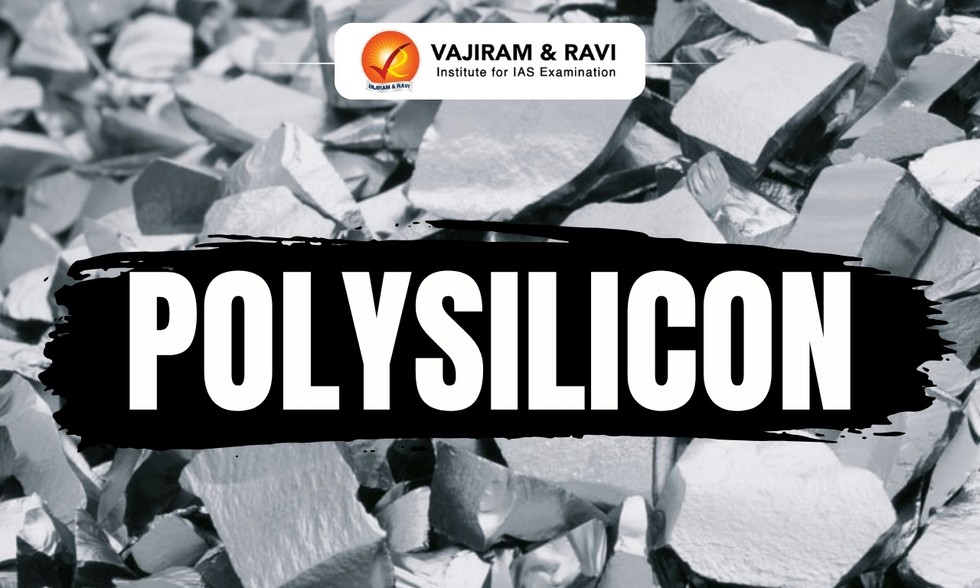
The government is working to add 30 gigawatts (GW) of polysilicon manufacturing capacity by 2030 and is working on a subsidy scheme.
About Polysilicon:
Polysilicon, also known as polycrystalline silicon or simply poly-Si, is composed of multiple tiny crystals or grains of silicon.
It is composed of multiple smaller silicon crystals fused together in a haphazard manner.
Polysilicon is highly pure and generates almost as much energy as pure mono-crystalline silicon.
Because of this, polysilicon is crucial to the solar industry as it plays a key part when manufacturing solar cells that are used in solar panels.
To produce solar modules, polysilicon is melted at high temperatures to form ingots, which are then sliced into wafers and processed into solar cells and solar modules.
It is also used in the semiconductor industry to manufacture integrated circuits and other electronic components.
It is produced by purifying metallurgical-grade silicon into a high-purity form.
There are two main methods to produce high-quality polysilicon that can be used for solar cell manufacturing: the Siemens process and fluidized bed reactor (FBR) technology.
Global production is highly concentrated.China accounts for the large majority of solar-grade polysilicon output.
Dear Student,
You have still not entered your mailing address. Please enter the address where all the study materials will be sent to you. (If applicable).