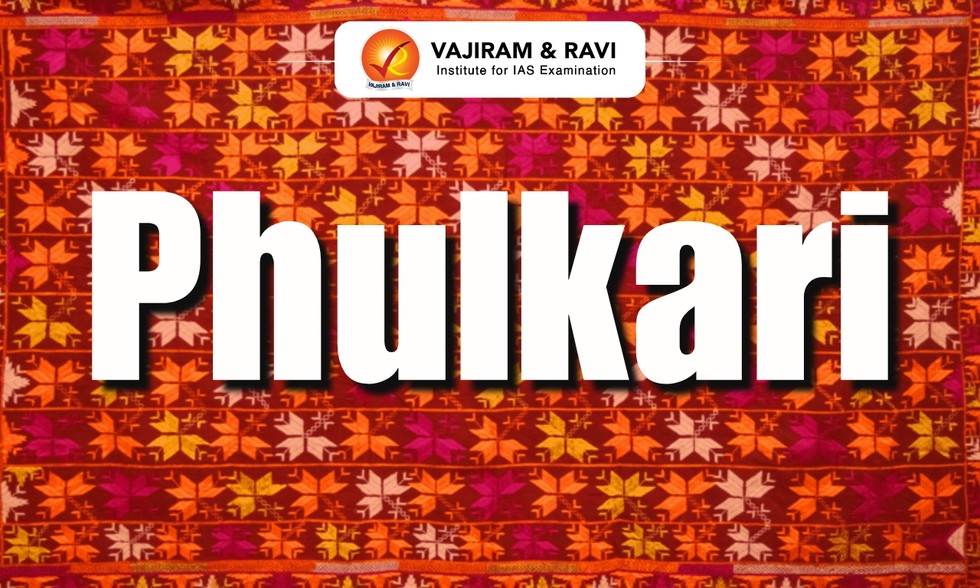
Several years after Punjab’s traditional embroidery, Phulkari, secured the coveted Geographical Indication (GI) tag, the craftspersons who keep the centuries-old practice alive continue to struggle for recognition and a sustainable livelihood.
About Phulkari:
Phulkari, meaning “flower work,” is a traditional embroidery art of Punjab.
There are various theories about the origin of phulkari.
Some believe this embroidery dates back to the 7th century CE, while others suggest it originated from Iran, where it was known as Gulkari.
However, distinct styles of phulkari have been identified, making it uniquely Punjabi.
References to phulkari can be found in ancient texts, folk legends, and literature, with the earliest mention in the 18th-century Punjabi literature.
It received a Geographical Indication (GI) tag in 2010.
Features:
It's an amalgam of cotton and silk.
The cloth used is usually hand-woven thick cotton, called ‘ khadder’. While the threads are thin, lustrous, and breakable silk, called ‘pat’.
The cloth is usually dyed red, but can be white, grey, or black
And the treads are a myriad of colors, ranging from the rich dark pink to soothing off-whites.
The stitch is intricate, small, and completely fills the cloth. The stitch can be vertical, horizontal, or diagonal to create the shadow effect.
Phulkari embroidery makes use of the least complicated patterns to create extremely intriguing designs.
The designs and patterns can vary from geometrical figures to flowers to local fauna. Peacocks, elephants, birds, and camels appear frequently.
Phulkari’s product range includes embroidered chaddars, dupattas, and stoles, traditionally worn by brides or for ceremonies.
Dear Student,
You have still not entered your mailing address. Please enter the address where all the study materials will be sent to you. (If applicable).