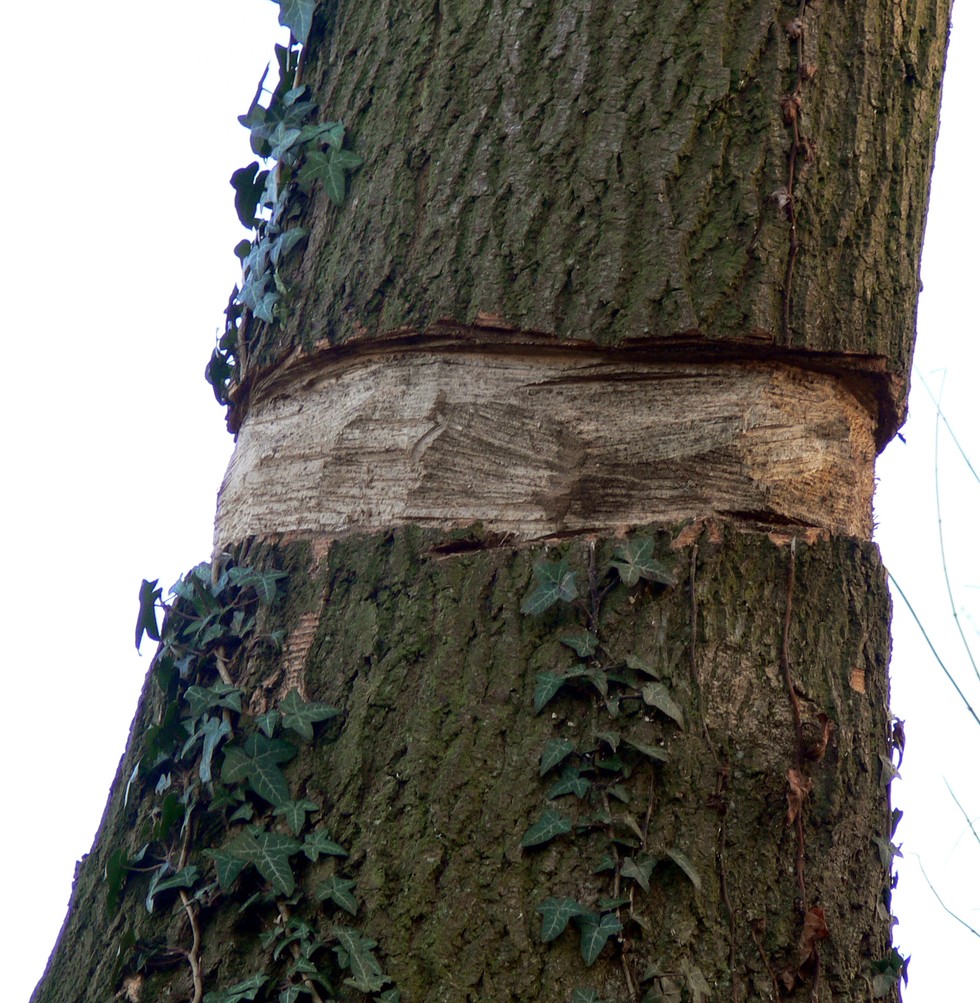
In an attempt to save over 500 trees, which were girdled allegedly by encroachers in Karka village deep inside the Udanti Sitanadi Tiger Reserve (USTR) recently, the Chhattisgarh forest department is seeking expert help – in the form of a “surgery” or bridge-grafting technique.
About Girdling:
Girdling is a commonly used habitat and forest management technique that deadens a tree without felling it for a specific purpose.
Girdling involves the removal of bark and cambium from the target tree using continuous and connected cuts that completely encircle the entire tree.
It destroys the cambium so no growth can occur and disrupts the flow of water and nutrients in the tree.
As a result, roots are starved of nutrients, and the plant cannot grow more stems and foliage.
Girdling is often used to control or eradicate large woody species where physical removal of woody biomass would be undesirable, unpopular, or cost prohibitive.
This technique generally has a low impact on cultural resources, erosion, and surrounding habitat because it is highly selective and does not disturb soil.
What is Cambium?
It is a layer of actively dividing cells between xylem (wood) and phloem (bast) tissues that is responsible for the secondary growth of stems and roots.
In secondary growth, a plant grows wider. Contrast this to primary growth, in which a plant grows taller.
The cambium originates from undifferentiated cells that have retained their embryonic capacity for continued growth and differentiation.
A cambium may also form within callus tissues—masses of cells that grow over the injured surface of a wound, leading to healing.
In a typical woody stem, the arrangement from outside to inside is:
Dear Student,
You have still not entered your mailing address. Please enter the address where all the study materials will be sent to you. (If applicable).