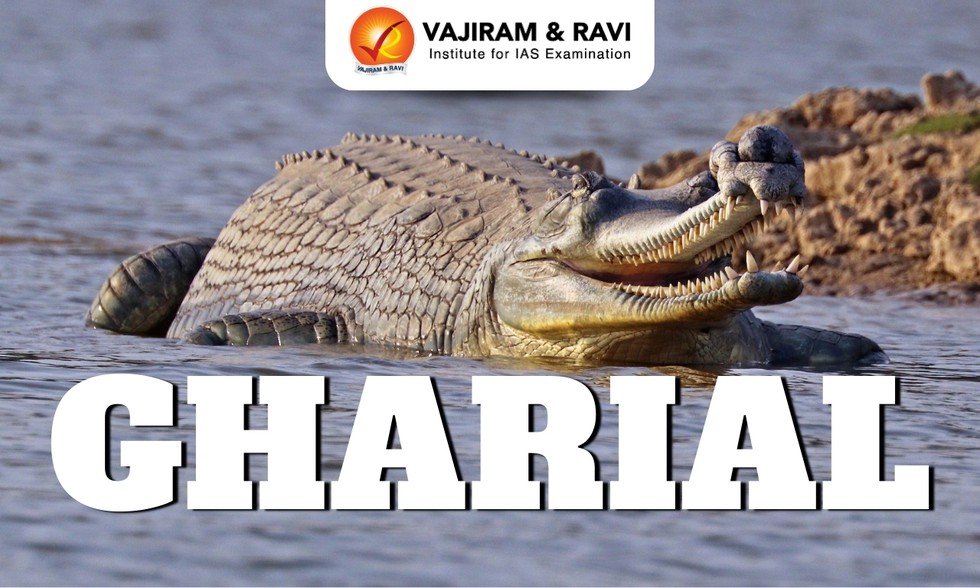
Despite significant existential threats, a comprehensive survey across the Ganga River basin recently revealed a population of 3,037 gharials (Gavialis gangeticus), the critically endangered fish-eating crocodile, inhabiting 13 of the surveyed rivers.
About Gharial:
It is a freshwater crocodile belonging to the Crocodylia Order and Crocodylidae Family.
Scientific Name: Gavialis gangeticus
The name ‘gharial’ comes from the Hindi word ghara, meaning pot or vessel, referring to the bulbous snout tip of adult males, which resembles an inverted pot.
Distribution:
Its range spanned the rivers of Bangladesh, Bhutan, India, Myanmar, Nepal, and Pakistan.
Their major population occurs in three tributaries of the Ganga River: the Chambal and Girwa Rivers in India and the Rapti-Naryani River in Nepal.
The Gharial reserves of India are located in three States: Uttar Pradesh, Madhya Pradesh, and Rajasthan.
Features:
It is one of the largest crocodilian
They have thick skin covered with smooth epidermal scales that do not overlap.
The snout of the gharial is uniquely the thinnest and most elongated among all the crocodilians.
In addition, the adult males sport a large bulb at the tip of their snout, called the ‘ghara’.
It is also the most aquatic of all crocodilians, for it never moves far from the water. Individuals typically only leave the water to bask and nest on sandbanks.
Reproduction: They mate during November–January and lay eggs March–May.
Dear Student,
You have still not entered your mailing address. Please enter the address where all the study materials will be sent to you. (If applicable).