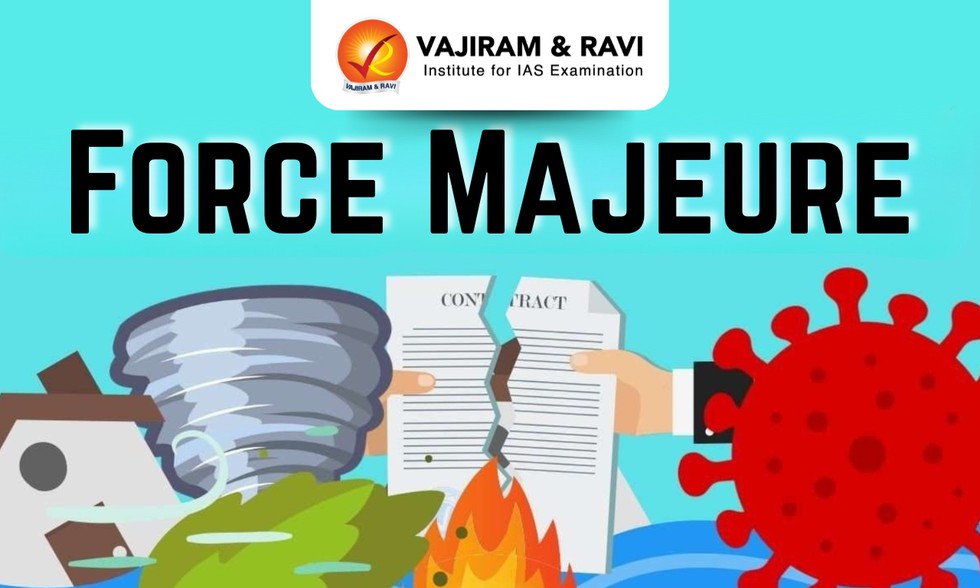
Several Gulf energy producers recently declared force majeure on oil and gas shipments after disruptions to shipping through the Strait of Hormuz.
About Force Majeure:
The concept of force majeure refers to an extraordinary eventrendering the legal obligations between two or more contractually bound parties impossible to fulfill.
The phrase comes from French and literally means “superior force’’.
It is related to the concept of an act of God, an event for which no party can be held accountable. This type of event must be entirely beyond the parties’ reasonable control.
As a precautionary measure against breach of contract, many commercial agreements contain force majeure contract clauses enumerating a list of major events that could result in non-performance of contractual duties.
Force majeure does not encompass events that are predictable, preventable, or controllable, or that result from the negligence or malfeasance of one or more parties.
Force majeure incidents typically include wars, natural disasters (e.g., earthquakes), terrorist attacks, epidemics, and civil unrest, such as riots.
When a force majeure clause is triggered, any party affected by the event must notify the other party or parties to the contract.
The affected parties will describe the start date and circumstances of the incident and cite the specific section in the contract that allows them to declare a force majeure incident.
The contracting parties must also prove their reasonable efforts to mitigate the circumstances that have rendered the fulfillment of their duties impracticable.
Such events may result in theparties delaying their obligations for a period of time, revising the contract terms, or agreeing on the contract’s cancellation.
The application of force majeure can vary across legal systems, with some jurisdictions requiring a more stringent definition than others.
In India, the doctrine of force majeure is governed by section 56 of the Indian Contract Act, 1872.
It provides that a contract becomes void if an act to be performed under the contract becomes impossible after the contract is made, or, by reason of some event, which the promisor could not prevent, the act to be performed becomes unlawful.
Force majeure conflicts with the concept of “pacta sunt servanda,”a principle in international law that agreements must be kept and not wriggled out of.
Dear Student,
You have still not entered your mailing address. Please enter the address where all the study materials will be sent to you. (If applicable).