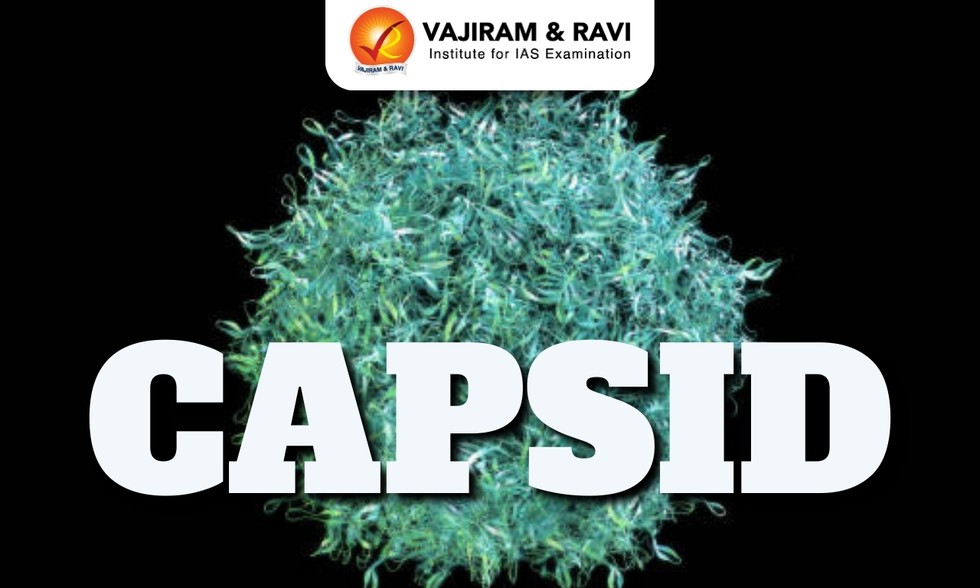
A new study found that to escape the drug Lenacapavir, HIV must damage its own capsid, reaffirming that the viral capsid is an effective target for antiviral therapy.
About Capsid:
A capsid is a three-dimensional proteinaceous capsular shell around a virus that encloses the viral genetic material.
It is located just below the viral envelope.
The capsid is made of several repeating finite numbers of protein subunits known as capsomeres or protomers.
The capsomeres of the protein coat can be associated with or may be closely related to the viral genetic material or nucleic acid.
The complexity of the capsid is dictated by the virus’s own genetic material. The more complex the genome, the more intricate the protein shell must be.
Some complex viruses have capsids with non-protein components like lipids, or in certain viruses, the capsid is further enclosed in a glycoprotein layer; such capsids are known as enveloped capsids.
The viral capsid is in the nanometer (nm) size range and possesses complex and unique mechanical properties.
It serves multiple functions, namely, encapsulating and protecting viral genetic material and transferring of genetic material to the required place in the new host.
For serving all these functions, the capsid needs highly specific mechanistic and functional flexibility as well as strength.
Dear Student,
You have still not entered your mailing address. Please enter the address where all the study materials will be sent to you. (If applicable).