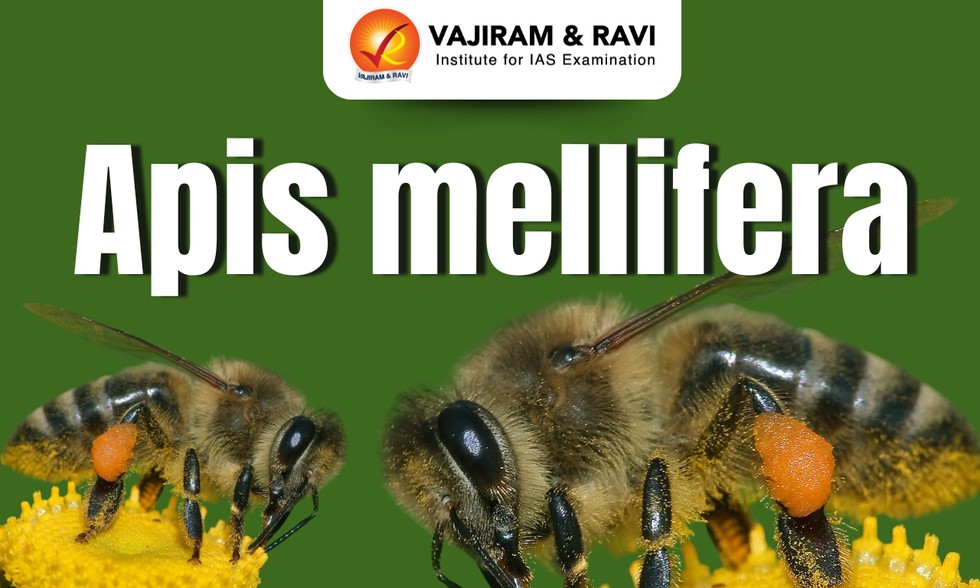
By successfully demonstrating that Apis mellifera can survive sub-zero temperatures, the CSIR-Indian Institute of Integrative Medicine (IIIM) Pulwama recently introduced a breakthrough likely to help beekeepers avoid the costly practice of migrating their hives to the plains during winter.
About Apis mellifera:
Apis mellifera, the Western bee or European bee, is the most common species of honey bee worldwide.
It is the most widely distributed and well-known domesticated species of insect in the world.
It is commercially exploited for products such as honey, wax, and propolis, and it is used for pollination of multiple crops.
Habitat and Distribution:
It is native to Europe, Western Asia, and Africa.
Human introduction of Apis mellifera to other continents started in the 17th century, and now they are found all around the world, including East Asia, Australia, and North and South America.
They prefer habitats that have an abundant supply of suitable flowering plants, such as meadows, open wooded areas, and gardens.
They can survive in grasslands, deserts, and wetlands if there is sufficient water, food, and shelter.
They need cavities (e.g. in hollow trees) to nest in.
Features:
Like all honey bees, the western honey bee is eusocial, creating colonies with a single fertile female (or "queen"), many normally non-reproductive females or "workers," and a small proportion of fertile males or "drones."
Dear Student,
You have still not entered your mailing address. Please enter the address where all the study materials will be sent to you. (If applicable).