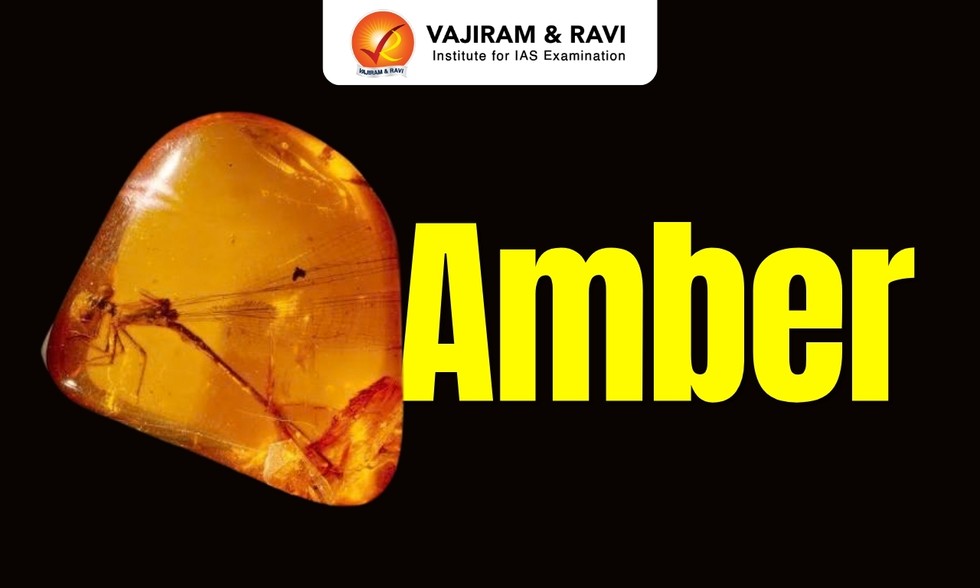
An elderly woman in Romania unknowingly used a large piece of amber as a doorstop, overlooked by thieves who stole the jewellery and ran away.
About Amber:
It is a fossilized tree resin that has hardened and undergone chemical and geological changes over millions of years.
Formation:
The resin that formed amber came from trees that grew millions of years ago.
Over time these trees and their resin became buried beneath Earth’s surface.
The trees eventually decayed and disappeared.
But the resin hardened further until it became amber.
Many pieces of amber contain the remains of insects or plants in the form of fossils. These living things were trapped in the resin before it hardened into amber.
Scientists study these creatures to learn how living things have changed over millions of years.
Amber has been found throughout the world. However, most of it comes from the shores of the Baltic Sea in northern Europe. This amber is buried in sands that are 40 million to 60 million years old.
Appearance:
Amber occurs as irregular nodules, rods, or drop-like shapes in all shades of yellow with nuances of orange, brown, and, rarely, red.
Milky-white opaque varieties are called bone amber.
The turbidity of some amber is caused by inclusions of many minute air bubbles.
Deeply coloured translucent to transparent amber is prized as gem material.
Ornamental carved objects, beads, rosaries, cigarette holders, and pipe mouthpieces are made from amber.
Amberoid, or “pressed amber,” is produced by fusing together small pieces of amber under pressure. Parallel bands, or flow structure, in amberoid help to distinguish it from natural amber.
Dear Student,
You have still not entered your mailing address. Please enter the address where all the study materials will be sent to you. (If applicable).