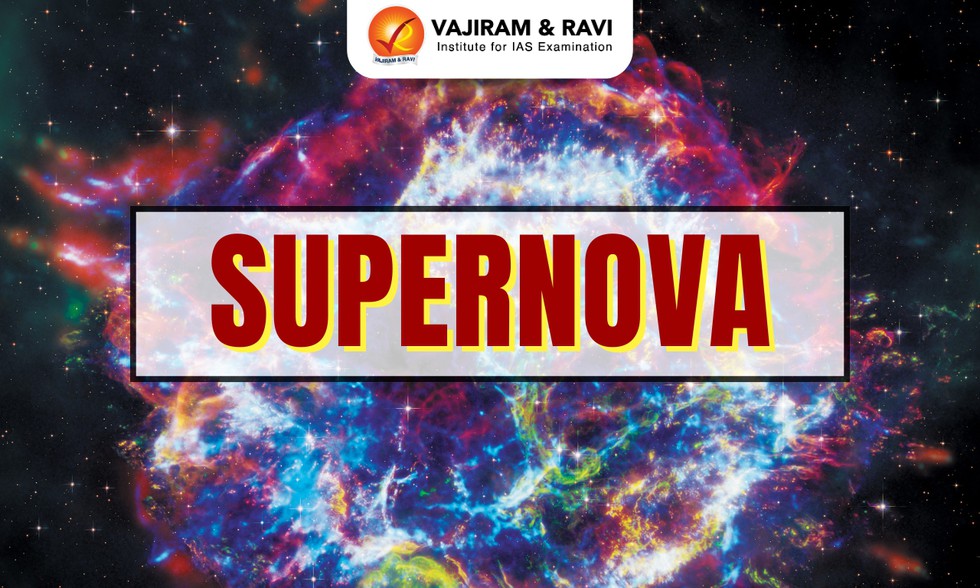
A distant gamma-ray burst has led astronomers to a rare supernova from the Universe’s early years, revealed recently by the James Webb Space Telescope (JWST).
About Supernova:
A supernova is the name given to the cataclysmic explosion of a massive star.
They are the largest explosions that take place in space.
A star can go supernova in one of two ways:
Type I Supernova: A star accumulates matter from a nearby neighbor until a runaway nuclear reaction ignites.
Type II Supernova: A star runs out of nuclear fuel and collapses under its own gravity.
It can emit more energy in a few seconds than the sun.
These spectacular events can be so bright that they outshine their entire galaxies for a few days or even months.
They can be seen across the universe.
They’re also the primary source of heavy elements in the universe.
How Common are Supernovas?
Astronomers believe that about two or three supernovas occur each century in galaxies like our own Milky Way.
Because the universe contains so many galaxies, astronomers observe a few hundred supernovas per year outside our galaxy.
Dear Student,
You have still not entered your mailing address. Please enter the address where all the study materials will be sent to you. (If applicable).