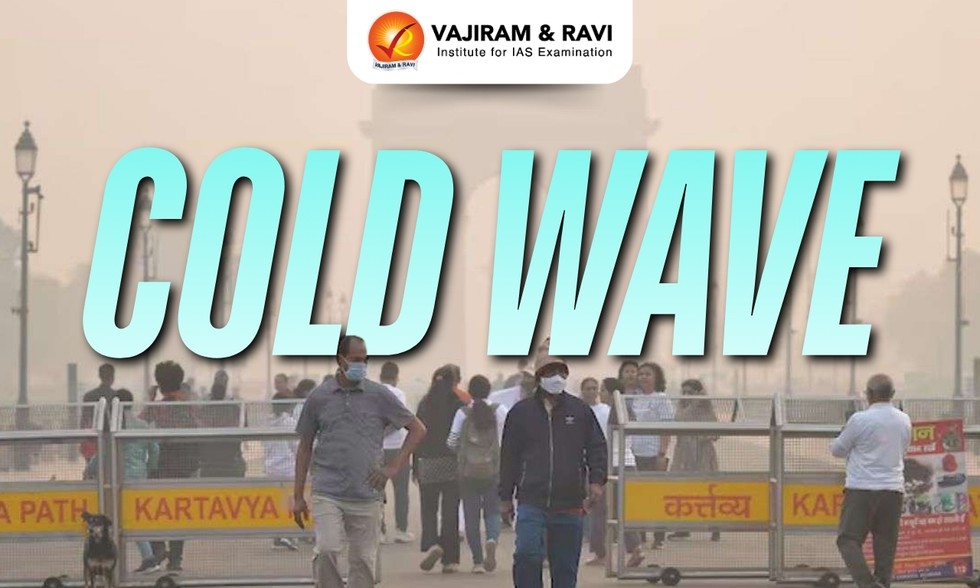
Higher than normal cold wave days are expected to impact parts of central India as well as some regions in northwest and northeast India, according to the India Meteorological Department (IMD).
About Cold Wave:
Cold waves are unusual weather occurrences caused by extremely low temperatures in the near-surface atmosphere.
Their duration can range from several days to a few weeks, contingent upon the geography and climatic conditions of the region.
The India Meteorological Department (IMD) defines a cold wave as a rapid fall in temperature within 24 hours.
This is distinguished by a marked cooling of the air, or with the invasion of very cold air, over a large area.
As per IMD, a cold wave is considered when the minimum temperature of a station is 10°C or less for plains and 0°C or less for hilly regions.
A cold wave and severe cold wave is considered a negative departure from normal i.e., 4.5°C to 6.4°C and more than 6.4°C in hill stations,
Similarly, the departure in minimum temperature of ≤ 04°C and ≤ 02°C for plains is considered a cold wave and severe cold wave, respectively.
Cold waves are predominantly experienced during the period December-February, when minimum temperatures drop to very low levels, especially over the northern parts of India.
Health Risks:
Exposure to extreme cold can lead to frostbite, hypothermia, and other cold-related illnesses.
Non-freezing cold injuries, such as Immersion Foot—caused by prolonged exposure to cold, wet conditions—are also a risk.
In extreme cases, cold exposure may result in fatalities if adequate precautions are not taken.
Dear Student,
You have still not entered your mailing address. Please enter the address where all the study materials will be sent to you. (If applicable).