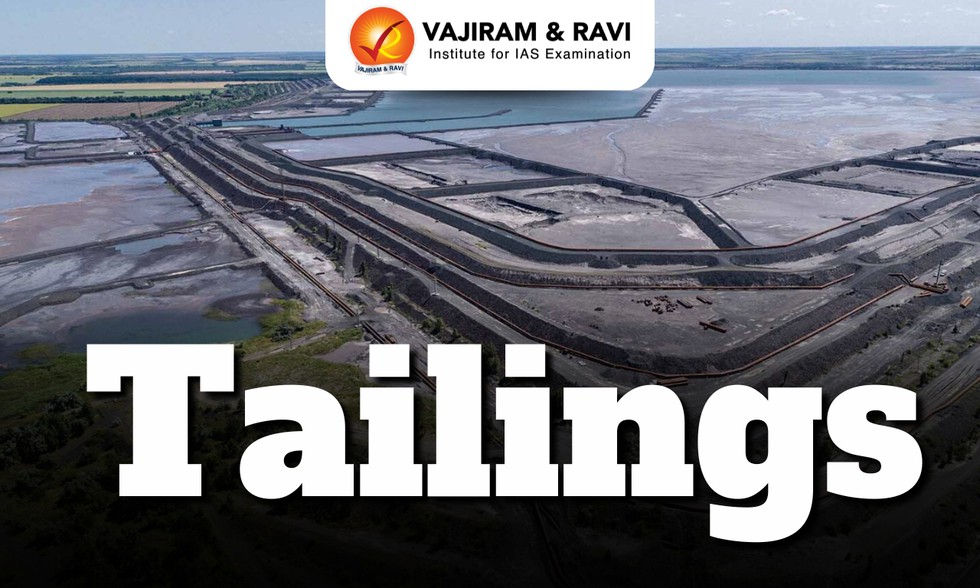
About Tailings:
- Tailings are the leftover materials from the processing of mined ore.
- They consist of finely ground rock, unrecoverable or uneconomic metals, chemicals, organic matter, and effluent from the extraction process.
- They usually take the form of a liquid slurry made of fine mineral particles, created as mined ore is crushed, ground, and processed.
- Effective tailings management is integral to the safe and sustainable production of metals and minerals.
- Tailings can be stored in a variety of ways; which way depends on numerous factors, for instance, the local topography, how much rainfall an area gets, whether there is regular or irregular seismic activity recorded, the type of mineral being mined, and how close the mine is to populated areas.
- There is no one-size-fits-all solution; each tailings facility (also commonly known as a tailings storage facility) is unique.
- Dams, embankments, and other types of surface impoundments are by far the most common storage methods used today.
India's First Tailings Policy for Critical Minerals:
It sets guidelines for exploration of critical minerals from primary as well as secondary sources like mine dumps and tailings of existing mines.
- The new policy is developed on the idea that a few commodities currently mined in India as primary ore may have scope for recovery of companion metals or elements from the tailings, anode slimes, pot linings, and slags.
- For example, a copper mine may have Selenium, Tellurium, Molybdenum, Cobalt, Rhenium, Gold, and Silver as companion elements.
- Similarly, Zinc is found along with Germanium, Silver, Cadmium, and Indium.
- Critical minerals, including lithium, cobalt, nickel, rare earth elements (REE), etc., are vital for solar panels, wind turbines, batteries and are essential for India’s economic growth.