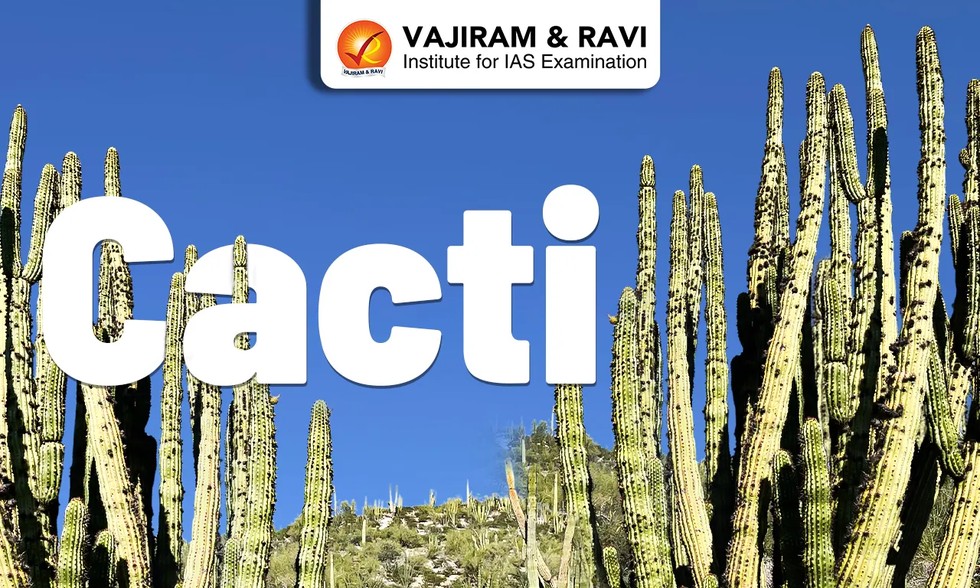
New research reveals that cacti create new species surprisingly quickly, despite their slow-growing reputation.
About Cacti:
Cacti are a type of plant that is known for its thick, fleshy stem and its spines.
These plants are native to the deserts of North and South America and have adapted to the dry, hot climate.
Cacti come in a wide variety of shapes and sizes.
One of the most unique things about cacti is their ability to store large amounts of water in their stems.
This adaptation helps them to survive in desert conditions where water is scarce.
When it rains, cacti absorb water through their roots and store it in their stems. This water is used by the plant during dry periods.
The stem is covered in a layer of protection that helps prevent evaporation.
Cacti also have specialized roots that are able to absorb water quickly.
The shape of a cactus also plays a role in its water-saving abilities.
Most cacti have a columnar shape, which means that they have a narrow base and a wide top.
This shape allows the plant to minimize its surface area so that less water is lost through evaporation.
There are two main types of cacti: opuntias and columnar cacti.
Opuntias, also called prickly pears, are cacti that have flat, fleshy pads instead of the traditional cylindrical stem. These plants are covered in spines, and they produce small, edible fruits.
Columnar cacti, on the other hand, have a tall, straight stem with ridges running up and down its length.
These cacti often grow to be quite large, and are home to many species of animals in their native habitats.
Cacti can be distinguished from other succulent plants by the presence of areoles, small cushionlike structures with trichomes (plant hairs) and, in almost all species, spines or barbed bristles (glochids).
Areoles are modified branches, from which flowers, more branches, and leaves (when present) may grow.
Dear Student,
You have still not entered your mailing address. Please enter the address where all the study materials will be sent to you. (If applicable).