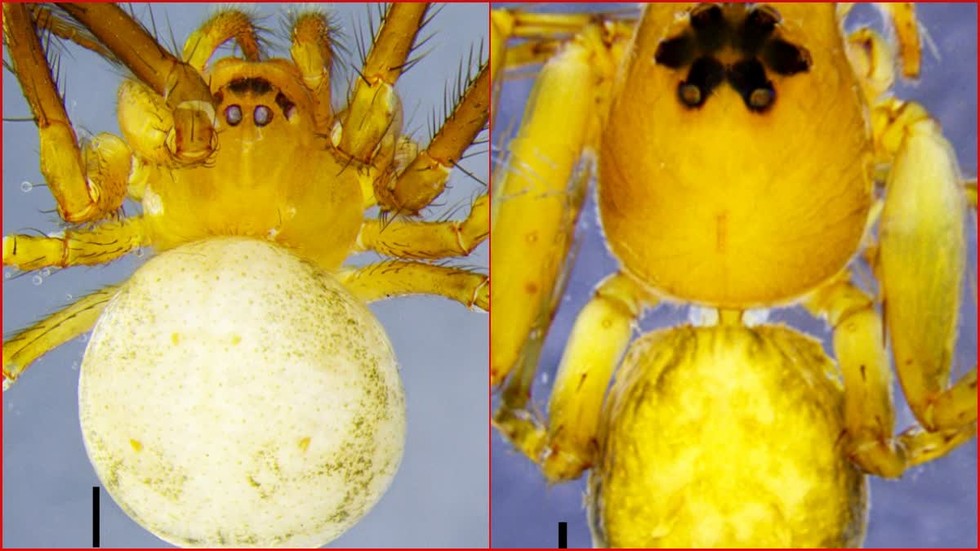
About Simonia lawbah:
- It is a new species of cave-dwelling ray spider.
- It was found inside Krem Lawbah Cave in Meghalaya.
- It belongs to the Theridiosomatidae family, commonly known as Ray Spiders. It marks the first-ever record of the genus Simonia in India.
- Measuring less than two millimetres, this tiny cave-dwelling spider is specially adapted to life in perpetual darkness.
- Scientists describe it as troglophilic, meaning it thrives in cave environments while retaining the ability to survive outside them under suitable conditions.
- Its most fascinating feature is the construction of an intricate cone-shaped “ray web.”
- These “ray webs” function like miniature slingshots, allowing the spider to launch its web at high speed to trap flying insects.
About Hamataliwa papikonda:
- It is a new species of lynx spider.
- It was recorded in the mixed deciduous forest canopy of Papikonda National Park in Andhra Pradesh.
- It represents the first documented occurrence of the genus Hamataliwa in Andhra Pradesh.
- Measuring just under 5 mm, the yellow-bodied spider belongs to the lynx spider family Oxyopidae and is an active predator that does not build webs.
- Instead, it relies on speed, agility and its spiny legs to capture prey.
- It has a distinctive hexagonal arrangement of eight eyes, which helps it track and hunt insects with precision.