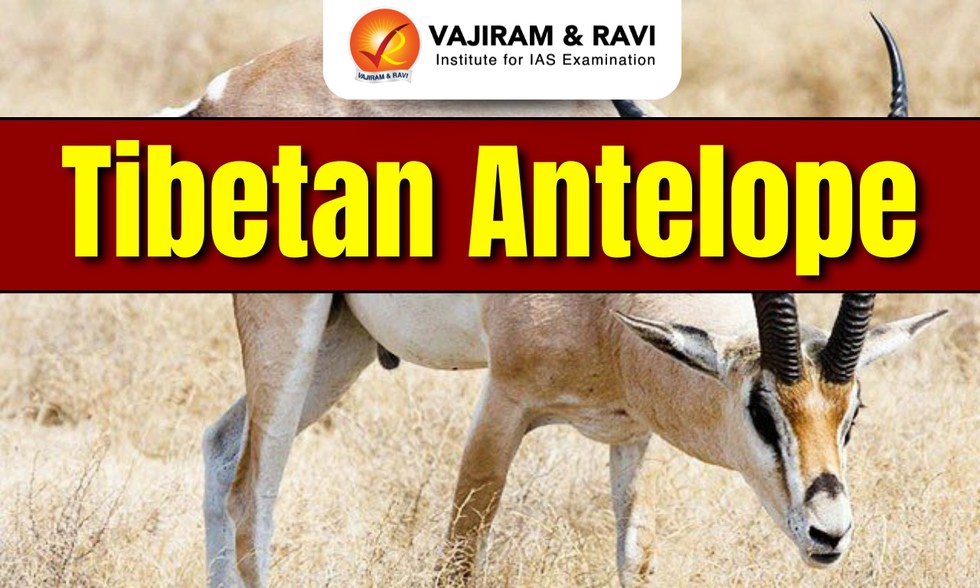
About Tibetan Antelope:
- The Tibetan antelope or chiru (Pantholops hodgsonii) is a medium-sized antelope.
- Appearance
- Male Tibetan antelopes are significantly larger than females, and can also be readily distinguished by the presence of horns and by black stripes on the legs, both of which the females lack.
- The fur of Tibetan antelopes is distinctive, and consists of long guard hair and a silky undercoat of shorter fibers.
- Habitat: They inhabit in open alpine, montane valleys, and cold steppe environments with sparse vegetation cover.
- Distribution: They are found almost entirely in China, where they inhabit Tibet, southern Xinjiang, and western Qinghai; a few are also found across the border in Chang Thang, Ladakh, India.
- Migration: They are a migratory species, often travelling as much as 400 kilometres between their summer and winter grounds.
- Diet: They are herbivores (folivores, graminivores) and feed on forbs, grasses, herbs, shrubland, and sedges.
- Conservation Status:
- IUCN Red List: Near Threatened
- CITES: Appendix I
- Wildlife (Protection) Act, 1972: Schedule I
What are Shahtoosh shawls?
- These are made from the hair of the Tibetan Antelope.
- It offers high levels of smoothness and warmth, Shahtoosh shawls became a highly expensive commodity.
- The Shahtoosh shawl trade has been banned globally since 1975 under CITES.