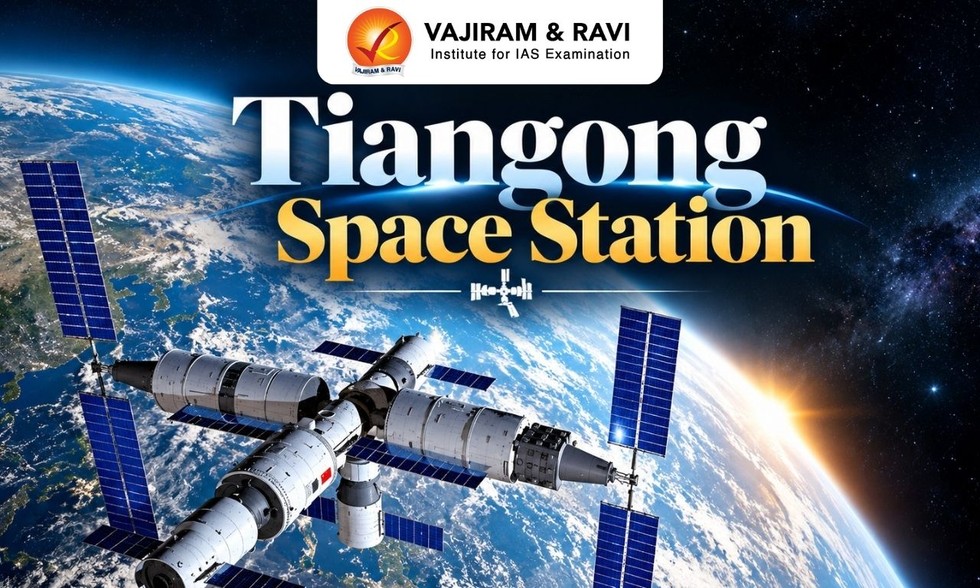
About Tiangong Space Station:
- The Tiangong Space Station, translating to ‘Sky Palace’, is a Chinese-owned and operated permanently crewed space station in Low Earth Orbit (LEO).
- It represents the third and final step of China’s Manned Space Program.
- The first module of the space station was launched in 2021, following two precursor missions, Tiangong-1 and Tiangong-2.
- The station consists of a core module known as Tianhe, which connects two science modules, Wentian and Mengtian, as well as a planned space telescope module, Xuntian.
- Xuntian is a huge, Hubble-like space telescope, which will share the space station's orbit and be able to dock with it for repairs, maintenance, and possibly upgrades.
- Tiangong orbits Earth at an altitude between 340 to 450 kilometers, approximately the same orbital height as the International Space Station (ISS).
- Tiangong is much smaller than the ISS, with only three modules compared with 16 modules on the ISS.
- Tiangong is also considerably lighter than the ISS, which weighs about 400 tons (450 metric tons); the Chinese station is about 20% as massive.
- But unlike the ISS, Tiangong is operated by a single nation.
- The station typically hosts three astronauts at a time for six-month stays. It can support six astronauts at a time during crew handovers.
- The aims of the Tiangong Space Station are to:
- Build a long-term, reliable space station in orbit.
- Guarantee the long-term health and safety of stationed astronauts.
- Provide conditions for scientific and technological experiments in space.
- The station serves as an in-orbit laboratory with enclosed experiment racks, each covering a different proposed experiment in the fields of:
- Space life sciences and biotechnology
- Microgravity fluid physics and combustion
- Material science in space
- Fundamental physics in microgravity
- The space station also features platforms for exposed and unpressurised external experiments.