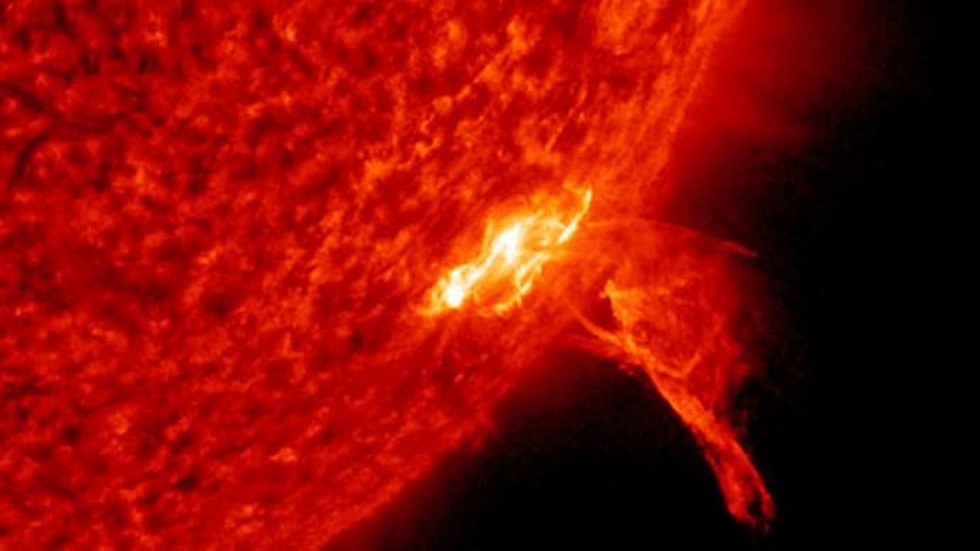
Researchers from the Indian Institute of Astrophysics (IIA) have made a significant breakthrough in understanding a long-standing solar mystery regarding solar radio burst.
About Solar Radio Burst:
It is defined as an intense solar radio emission associated with solar flares.
Origin: These are observed in radio wavelengths most frequently during solar transients, such as coronal mass ejections (CMEs) and flares.
SRBs are direct signatures of accelerated electrons in the solar atmosphere.
These are observed across a wide range of wavelengths, from millimetres to kilometres, corresponding to frequencies from the GHz to the kHz range.
Observations at short wavelengths correspond to distances close to the solar surface, while those at long wavelengths correspond to the large distances from the Sun.
Types: Considering the morphological characteristics, five main categories of solar radio bursts can be distinguished: Type I, Type II, Type III, Type IV, and Type V.
Impacts:
These solar transients have a direct impact on the near-Earth atmosphere.
It can interfere with Global Navigation Satellite System (GNSS) signals by reducing signal-to-noise ratio and causing loss of lock.
Dear Student,
You have still not entered your mailing address. Please enter the address where all the study materials will be sent to you. (If applicable).