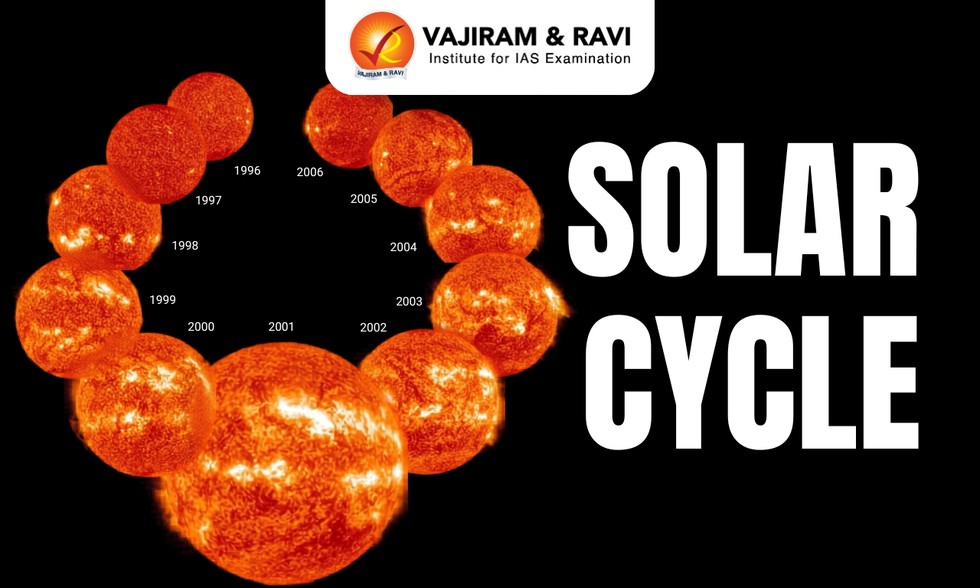
About Solar Cycle:
- It describes an approximately 11-year cycle of solar activity driven by the sun’s magnetic field.
- It is indicated by the frequency and intensity of sunspots visible on the surface.
- Every 11 years or so, the Sun’s magnetic field completely flips.
- This means that the Sun’s north and south poles switch places. Then it takes about another 11 years for the Sun’s north and south poles to flip back again.
- The solar cycle affects activity on the surface of the Sun, such as sunspots, which are caused by the Sun’s magnetic fields.
- As the magnetic fields change, so does the amount of activity on the Sun’s surface.
- It can be tracked by counting the number of sunspots.
- Cycle Stages:
- Solar minimum: It is the beginning of a solar cycle or when the Sun has the least sunspots.
- Solar maximum: It is the middle of the solar cycle or when the Sun has the most sunspots.
- As the cycle ends, it fades back to the solar minimum, and then a new cycle begins.
- Impact: The solar cycle has the potential to impact Earth’s climatic conditions through changes in solar radiation, cosmic rays, and ozone distribution.
What is Sun's supergranulation?
- The Sun's supergranulation refers to a physical pattern covering the surface of the quiet Sun with a typical horizontal scale of approximately 30,000 km and a lifetime of around 1.8 d.
- Supergranulation was discovered by Hart (1954) using Doppler images of the Sun.