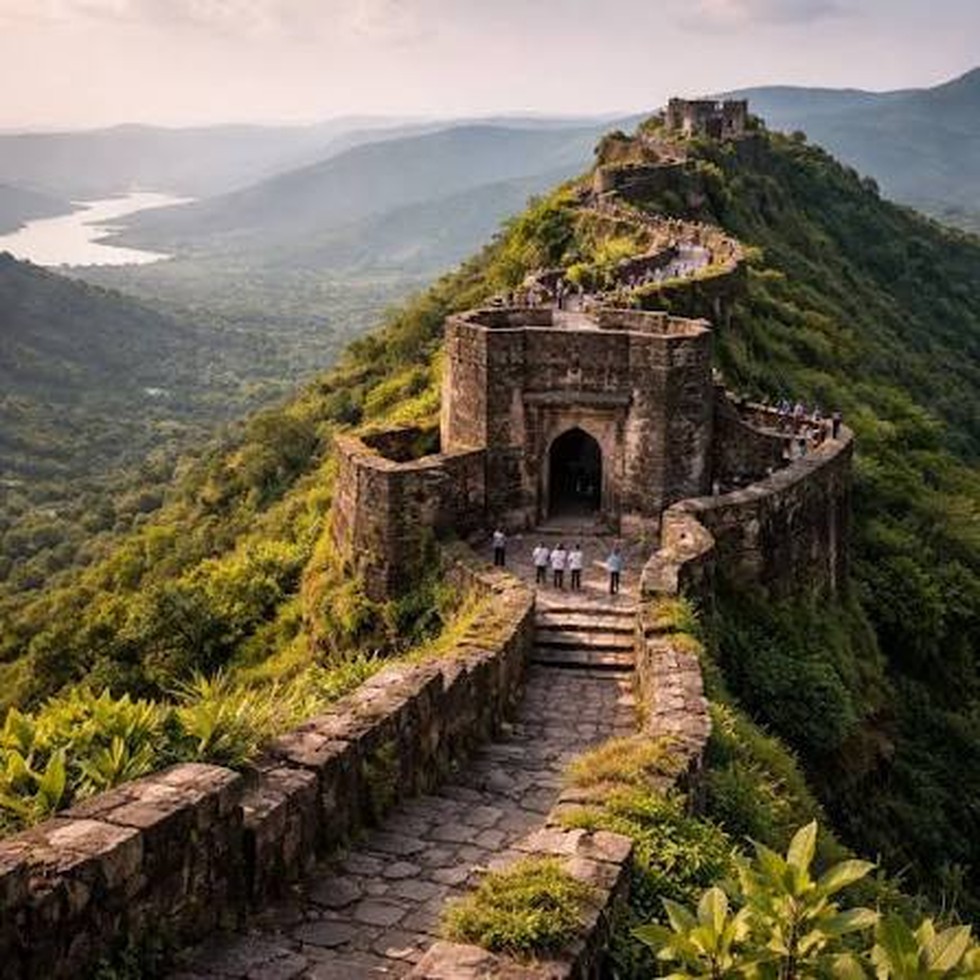
A 100-foot tall saffron flag will be erected by the Pune Municipal Corporation (PMC) at Sinhagad Fort in honour of Chhatrapati Shivaji Maharaj and the Maratha Empire.
About Sinhagad Fort:
Sinhagad, earlier known as ‘Kondhana’, is a fortress located near Pune, Maharashtra.
It was built in a strategic location and was surrounded by several other forts like Torna Fort, Purandar Fort, and Rajgad Fort.
History:
It was originally known as Kondhana and was named after the sage Kaundinya.
It has changed hands multiple times, with rulers from different dynasties leaving their mark.
Mohammed bin Tughalaq captured the fort from the Koli tribal chieftain, Nag Naik, in 1340 CE.
In 1496 CE,Malik Ahmad, the founder of the Nizam Shahi dynasty, took control of the fort.
Nearly 200 years later, the Maratha leader Shahaji Bhonsale captured the fort.
In 1647 CE, Shivaji held the stronghold.
In 1665 CE, as per the Treaty of Purandar, Shivaji handed over Sinhagad to the Mughals.
The fort’s famous chapter unfolded in 1670 when Chhatrapati Shivaji Maharaj orchestrated a daring mission to reclaim the fort from the Mughals.
The Battle of Sinhagad was led by the fearless Tanaji Malusare ( Shivaji’s favorite general), who, along with his brave warriors, scaled the steep cliffs under the cover of darkness.
Despite putting up a fierce fight, Tanaji succumbed to his injuries.
When Shivaji Maharaj heard of Tanaji’s sacrifice, he famously remarked, “Gad ala, pan Sinha gela” (The fort is won, but the lion is lost).
In honor of his valiant warrior, Shivaji Maharaj honoured the fort with the name Sinhagad Fort, or Lion’s Fort.
The fort remained under the control of the Marathas until 1818 CE, when it was surrendered to the British after the Third Anglo-Maratha War.
The fort was later used as a retreat for many European residents of Pune.
Architecture:
It is a marvel of Maratha architecture and engineering.
It comprises a strong fortified wall which runs for almost 2 miles.
The fort features two main entrances—the Pune Darwaza, facing Pune, and the Kalyan Darwaza, opening towards the Konkan region—both showcasing intricate stonework and strategic placement for enhanced security.
It has an advanced water storage system, which includes ancient rainwater harvesting techniques and natural reservoirs that ensure a continuous water supply.
The fort has several bastions, ramparts, walls, and gates that enclose its premises.
The fort also houses a temple dedicated to Goddess Kali, a brewery, some military sheds, and the tombs of Rajaram Chhatrapati (Shivaji’s youngest son) and Tanaji Malusare.
Dear Student,
You have still not entered your mailing address. Please enter the address where all the study materials will be sent to you. (If applicable).