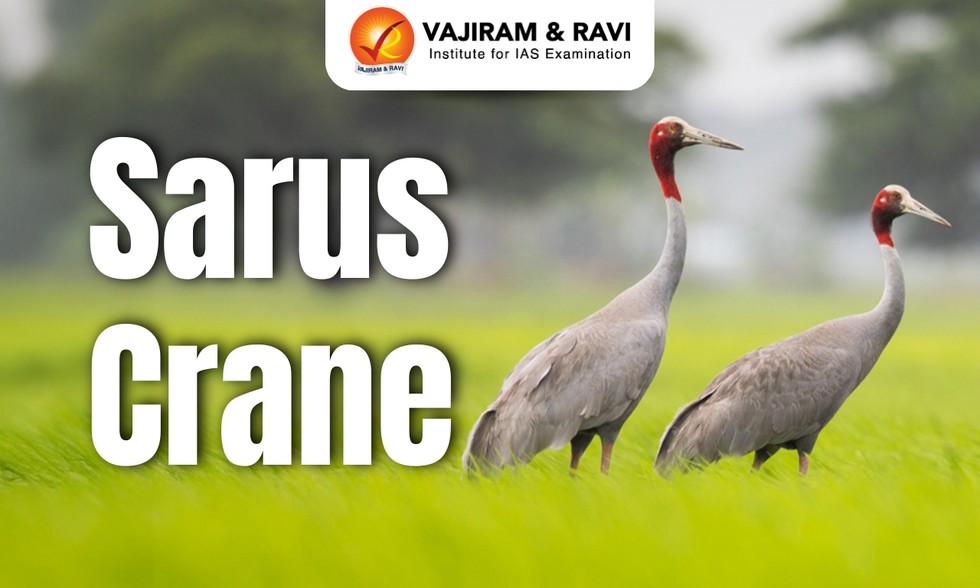
According to government census conducted across 68 forest divisions of Uttar Pradesh, the population of sarus cranes in the state has gone up by 634 or 3.1% in a year.
About Sarus crane:
It is the tallest flying bird in the world.
Habitat: They live mainly in wetlands such as canals, marshes, and ponds, sometimes near humans.
Distribution: They live in Southeast Asia, northern India, and northern Australia.
In India, most sarus cranes are widely distributed along the Gangetic plain and in eastern Rajasthan in the northern states of India. Population densities decrease going to the south.
This species is not known to be migratory.
Features of Sarus Crane:
It has a predominantly grey plumage with a naked red head and upper neck and pale red legs.
They are regarded as the least social crane species, found mostly in pairs or small groups of three or four.
They are monogamous birds and pairs mate for life.
Nests are constructed on water in natural wetlands or in flooded paddy fields.
Lifespan: It has been estimated that cranes in general can live 30 to 40 years.
Dear Student,
You have still not entered your mailing address. Please enter the address where all the study materials will be sent to you. (If applicable).