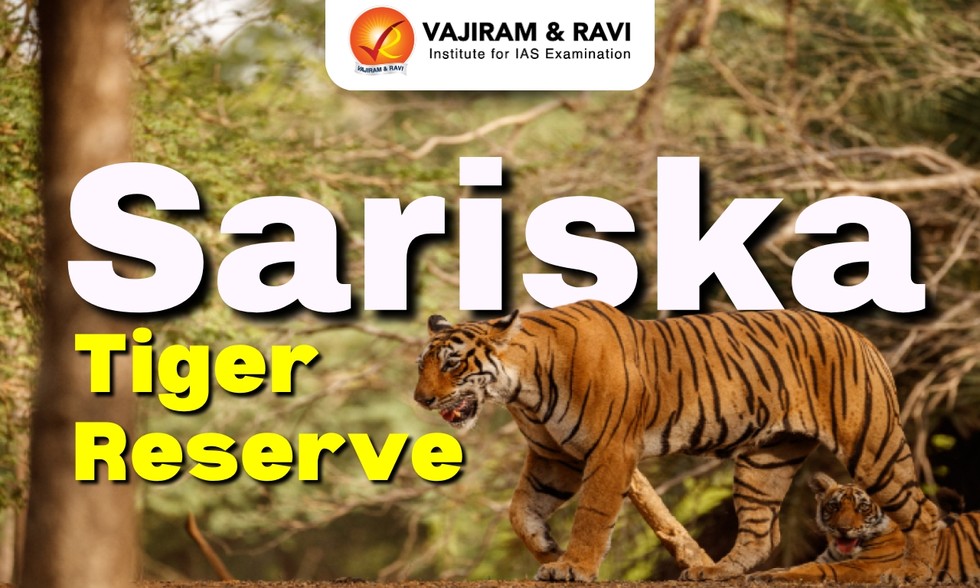
About Sariska Tiger Reserve:
- It is located in the Alwar district, Rajasthan.
- It is a part of the Aravali Range and the Kathiawar-Gir dry deciduous forests ecoregion.
- It was once a hunting ground of the Maharaja of Alwar before being proclaimed a natural reserve in 1955 and a national park in 1979.
- It became a Tiger Reserve under Project Tiger in 1979.
- It lost all its tigers to poaching in 2005.
- However, it holds the distinction of being one of the world’s earliest successful tiger reintroduction efforts.
- It is also famous for old temples, palaces, and lakes such as Pandu Pol, Bhangarh Fort, Ajabgarh, Pratapgarh, Siliserh Lake, and Jai Samand Lake.
- Topography: It possesses a rocky landscape, scrub thorn arid forests, grasses, hilly cliffs, and semi-deciduous wood.
- Vegetation: The vegetation corresponds to Northern Tropical Dry Deciduous Forests and Northern Tropical Thorn Forest.
- Flora:
- The area of this reserve is covered with dhok trees.
- Other species found include salar, kadaya, gol, ber, Banyan, gugal, bamboo, kair, adusta, etc.
- Fauna:
- A variety of other wild animals, like the leopard, sambhar, chital, nilgai, four-horned antelope, wild boar etc are found in the reserve apart from the tiger.
- Peafowl, grey partridge, sand grouse and crested serpent eagle are some of the birds found near the river bodies and the protected areas of the park.
- The largest population of peafowl in India resides in Sariska National Park.