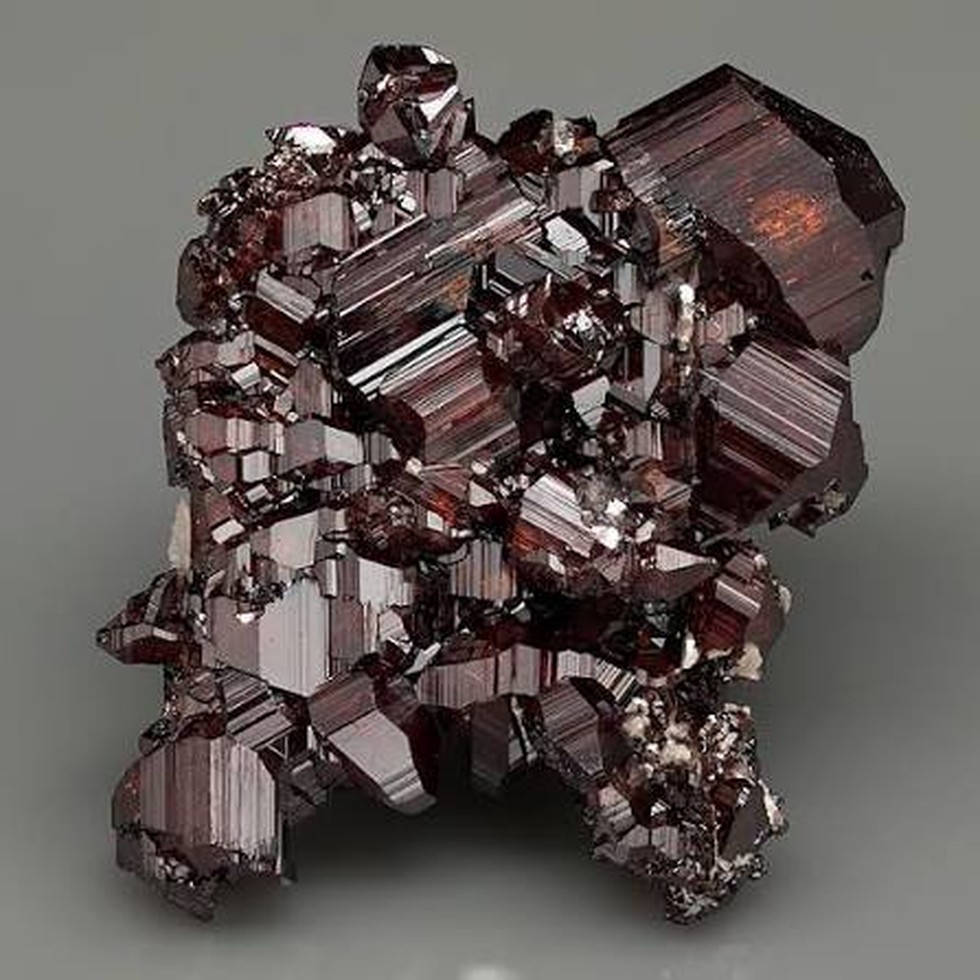
When a team at IIT-Delhi recently compared the members of a family of minerals called rutile oxides, they found a significant difference between metals and insulators that a well-known mathematical model could not explain.
About Rutile:
It is a mineral composed primarily of titanium dioxide, TiO2.
It is the most common and stable form of titanium dioxide found in nature.
It is one of the three main minerals of titanium, along with ilmenite and leucoxene.
It forms red to reddish brown, hard, brilliant metallic, slender crystals, often completely surrounded by other minerals.
Natural Rutile can contain up to 10% iron and large amounts of niobium and tantalum.
It was first described in 1803 by Abraham Gottlob Werner.
Occurrence:
It is found in igneous, metamorphic, and sedimentary rocksthroughout the world.
Rutile has a high specific gravity and is often concentrated by stream and wave action in "heavy mineral sands" that exist today in both onshore and offshore deposits.
Much of the world's rutile production is mined from these sands.
Rutile ore is largely available in countries like Australia, India, South Africa, Ukraine, and Sierra Leone.
India has significant rutile deposits in the coastal sands of states such as Kerala, Tamil Nadu, Odisha, and Andhra Pradesh.
Uses:
Rutile has several important industrial applications due to its high refractive index and strong resistance to heat and chemical corrosion.
One of its main uses is as a pigment in paints, plastics, ceramics, and other materials. It imparts a bright white color and excellent opacity to these products.
Rutile has minor uses in porcelain and glass manufacture and in making some steels and copper alloys.
Rutile is also used as a source of titanium metal, which has a wide range of applications in industries such as aerospace, automotive, electronics, and medical devices.
In addition to its industrial uses, rutile is valued as a collector’s mineral and gemstone.
Transparent rutile crystals are sometimes cut and polished for use as gemstones.
Dear Student,
You have still not entered your mailing address. Please enter the address where all the study materials will be sent to you. (If applicable).