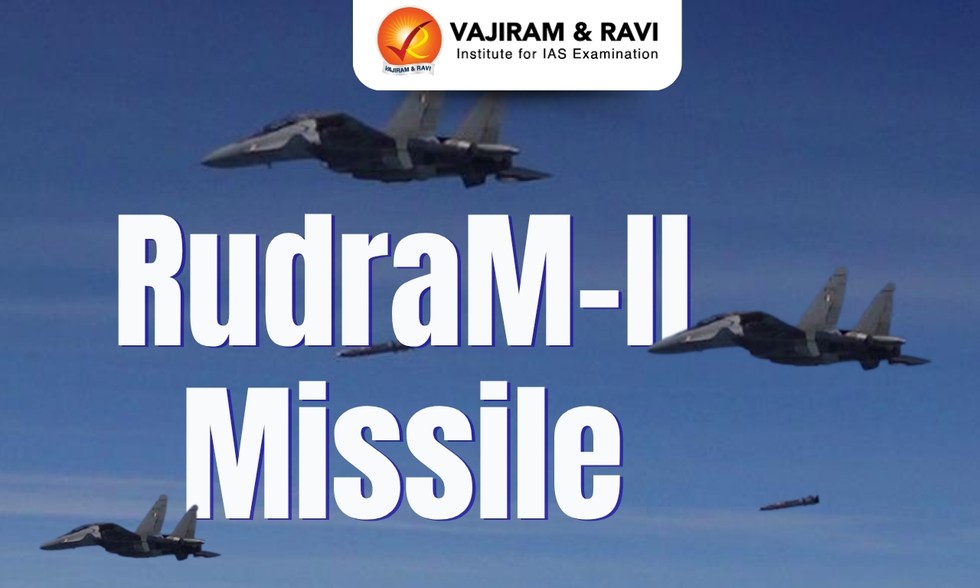
About RudraM-II Missile:
- It is an indigenously-developed solid-propelled air-launched missile system.
- It is meant for Air-to-Surface role to neutralise many types of enemy assets.
- It has been indigenously developed by Research Centre Imarat, Hyderabad as the nodal DRDO laboratory in collaboration with other sister labs
- Key Features of RudraM-II Missile:
- Speed: It can reach a peak speed of Mach 5.5.
- Range: It is capable of striking targets at a distance of approximately 300 km.
- Payload: It can carry a warhead weighing up to 200 kg.
- It can be deployed from aircraft like Sukhois flying at altitudes ranging from 3 to 15 km.
- It acts as a key force multiplier and intends to eventually replace the older Russian-origin Kh-31 anti-radiation missiles.
- It uses a hybrid navigation system combining an inertial navigation system, GPS and a sophisticated passive homing head that detects radio frequency emissions across a wide frequency band.
What is an Anti-radiation Missile?
- These are designed to detect, track and neutralise the adversary’s radar, communication assets and other radio frequency sources, which are generally part of their air defence systems.
- Such a missile’s navigation mechanism comprises
- Inertial navigation system: A computerised mechanism that uses changes in the object’s own position — coupled with GPS, which is satellite-based.
- Passive homing head: A system that can detect, classify and engage targets (radio frequency sources in this case) over a wide band of frequencies as programmed.